
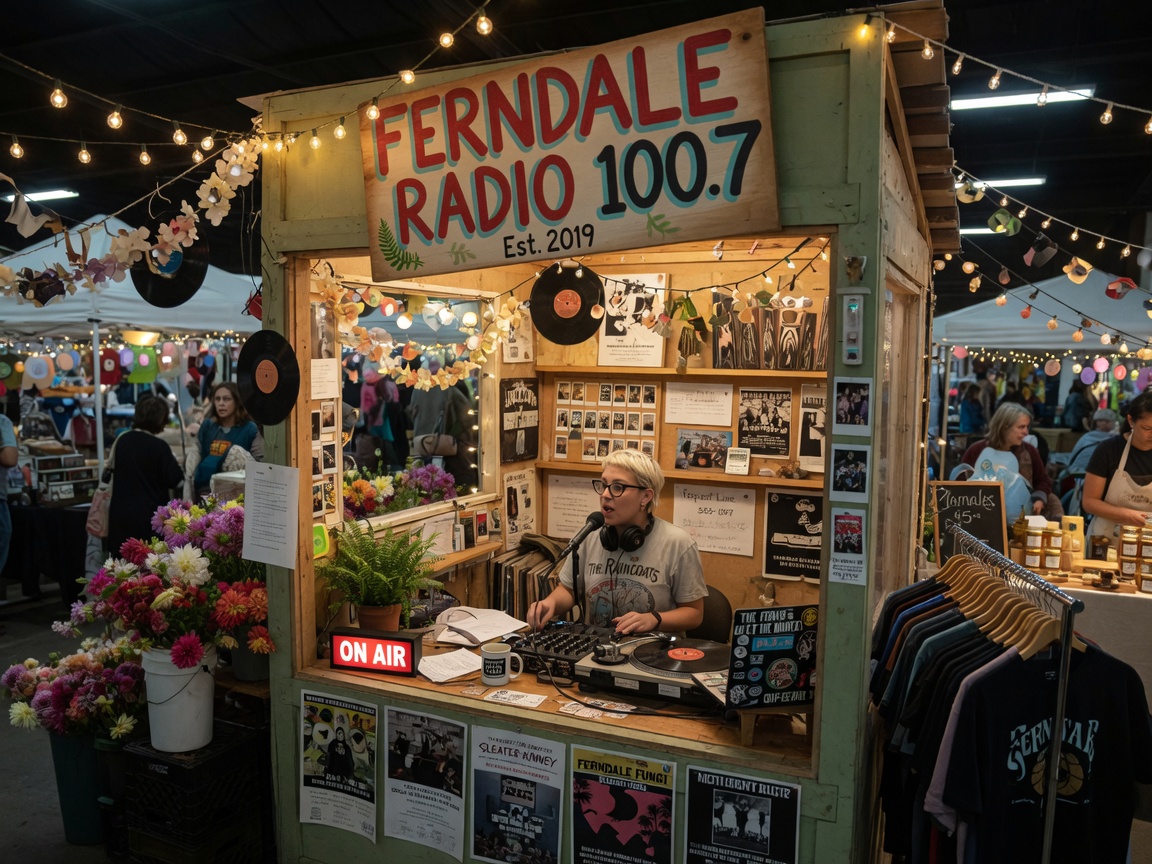
Getting WFCB-LP 100.7 "Ferndale Radio" on the air took a signed act of Congress, a nonprofit called Underwood V Radio, an exhaustive FCC interference study, and seven years of five friends refusing to give up. The station finally went live on Black Friday, broadcasting from a repurposed booth at the back of the Rust Belt Market at Nine Mile and Woodward, and it's been Ferndale's own voice ever since (Metro Times).
Underwood V: Five Friends Who Missed College Radio
The station's origin story runs through the Local Community Radio Act, signed by President Obama in 2011, which finally opened a path for small, city-based low-power FM stations, a category that had previously been all but locked out of dense radio markets like Detroit (Metro Times). Jeremy Olstyn, who managed Warren High School's Exile Radio, began organizing after the law passed, eventually joining Board President Michelle Mirowski, Dave Phillips, radio engineer Keith Fraley, and Dave Kim to found what they legally named Underwood V Radio, Incorporated, "Underwood Five Radio," the nonprofit that owns WFCB to this day (Wikipedia).
Their FCC construction permit was granted August 7, 2014, but building a station from a $15,000 shoestring budget, funded largely by in-person visits to Ferndale business owners, meant years more work before a single note actually hit the airwaves. Rust Belt Market owner Chris Best offered the station space rent-free in exchange for on-air mentions, a partnership Mirowski has described as feeling instantly right, "like a really good first date" (Metro Times).
A 100-Watt Signal, on Purpose
WFCB broadcasts at the maximum 100 watts allowed under its LPFM license, reaching roughly a 3.5-mile radius that covers Ferndale itself along with slices of Royal Oak, Hazel Park, Oak Park, Berkley, and Detroit's North End, a deliberately narrow footprint that's the entire point of the format (Second Wave Media). Board President Mirowski has been explicit that this small, hyper-local audience is exactly who the station is trying to reach, not a scaled-down version of a bigger ambition.
- Indie and local music, pulled from a hand-picked database that grew to roughly 1,000 songs, "stuff they don't play anywhere else," in station co-founder Dave Phillips' words.
- Live DJ shifts, a rotating roster of 15 to 20 volunteer hosts signing up online for shifts, roughly three live shows a day during the hours the Rust Belt Market is open.
- Local talk programming, including community features and interview segments covering neighborhood happenings.
- Automated overnight rotation, filling the hours outside live shifts with that same curated local and indie catalogue.
Phillips has summed up the station's north star simply: a mix of college radio spirit and the eclectic music WDET used to play a decade or more ago, back when Detroit's public station leaned harder into music discovery (Second Wave Media).
A City Built for This Kind of Station
Ferndale earns its reputation as one of Metro Detroit's most walkable, indie-spirited suburbs, the kind of place where a legendary independent record store like Found Sound sits blocks from live venues like The Loving Touch and the century-old Magic Bag theater, itself a converted 1921 movie house now hosting touring acts nightly (Poyst). WFCB isn't competing with Detroit's commercial giants, it's the neighborhood station for a neighborhood that already had the record stores and stages to support one, just not the frequency.
Why It's Worth a Spot in Your Rotation
If you want to hear what a genuinely volunteer-run, community-funded station sounds like, one built by people who spent seven years fighting for a 100-watt signal because they missed the freedom of college radio, WFCB delivers something algorithm-driven platforms can't fake. It's local in the most literal sense, and that's exactly why it's worth the listen even from thousands of miles away.
Stream WFCB-LP Ferndale Radio Free on Radio Shuffle
Tune in to WFCB-LP Ferndale Radio on Radio Shuffle, no account, no app, no fee. Press play and you'll hear exactly what five friends spent seven years making sure Ferndale would never have to go without.