
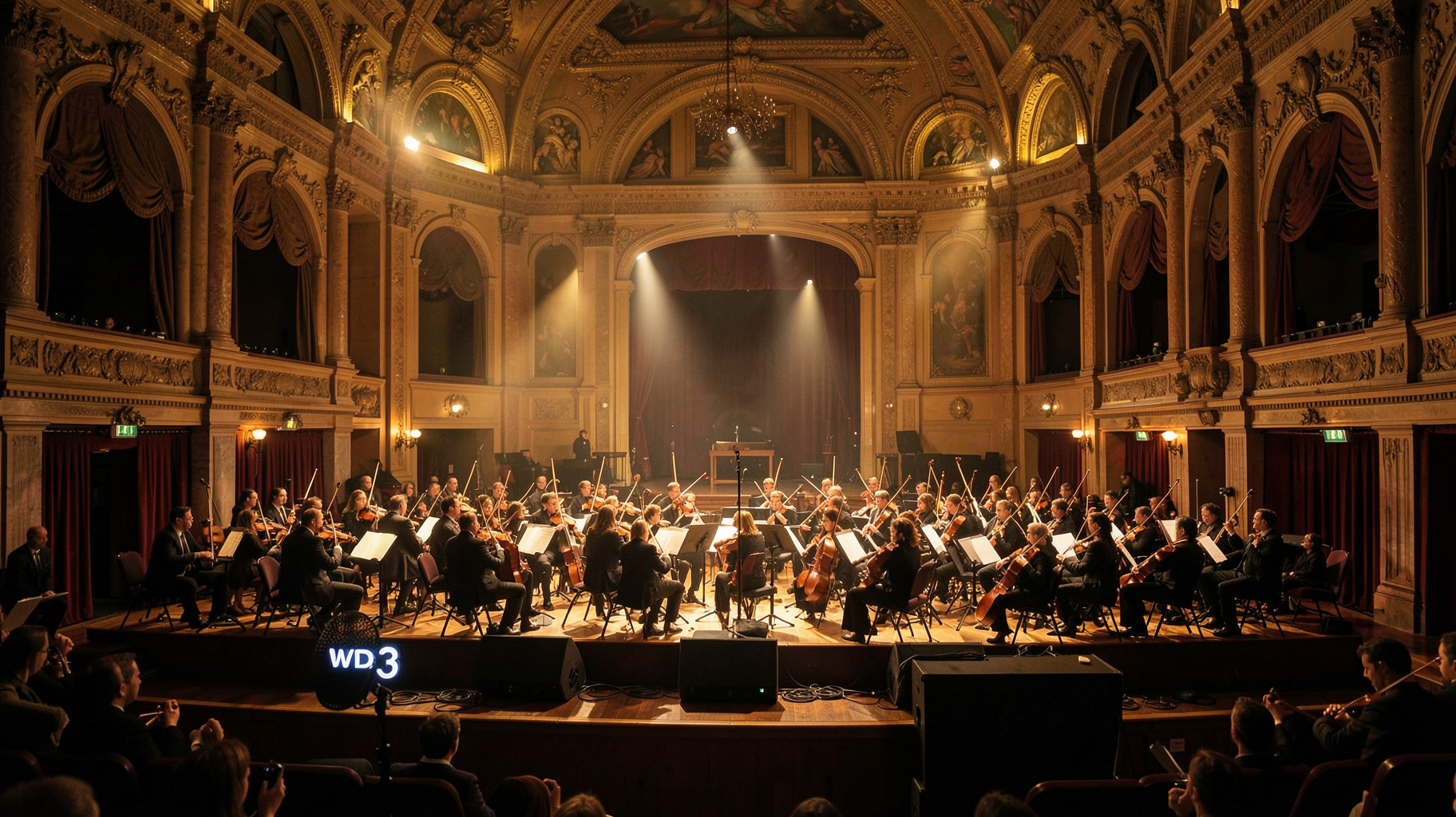
WDR 3 streams classical music, culture and spoken-word programming free on Radio Shuffle, broadcasting commercial-free out of North Rhine-Westphalia as the cultural flagship of Westdeutscher Rundfunk. It mixes concert repertoire spanning Baroque to modern composers with the kind of in-depth cultural talk that most commercial German radio has long since abandoned.
On Air Since 1964
WDR 3 first went to air on March 29, 1964, built from the start as a culture and politics-focused station with classical music at its core rather than an afterthought, according to the station's own history. More than sixty years later, that founding identity has barely shifted. The station remains commercial-free, funded through Germany's public broadcasting license system rather than advertising, which gives it room to program repertoire that a commercially pressured station would likely never risk.
A Daily History Lesson Born in Two Weeks
One of WDR's most enduring formats sits inside WDR 3's daily schedule almost by accident of good timing. Zeitzeichen, a roughly 15-minute daily documentary built around a single historical event or figure, was created by WDR editor Wolf Dieter Ruppel, who reportedly developed the entire format in about two weeks before it first aired on April 4, 1972, according to the show's own history. That first episode covered the 1942 siege of Leningrad, a 1967 speech by FDP politician Hildegard Hamm-Brücher, and the 1952 Walsum chemical plant disaster, three completely unrelated moments in history held together only by the format's own curiosity. Since the start of 2016, Zeitzeichen has aired on WDR 3 every day from 5:45 to 6:00 in the evening, more than fifty years after a two-week improvisation became one of German public radio's longest-running fixtures.
Classical Music Without the Gatekeeping
WDR 3 presents its classical programming with an emphasis on accessibility rather than connoisseurship, running concert-hall repertoire, chamber music and vocal works from the Baroque era through moderate modernism in a way designed to welcome casual listeners rather than reward only specialists. That approach has helped the station become one of the best-known cultural broadcasters in Germany, carrying weight both within North Rhine-Westphalia and nationally among listeners who want serious music without a velvet-rope attitude attached to it.
A Signal Built to Travel Past Its Home Region
Though WDR 3 is rooted in North Rhine-Westphalia, where it broadcasts on FM and DAB+, its reach extends well beyond the region through DVB-S and DVB-C satellite and cable distribution nationwide, and through internet streaming worldwide. A station built around a specific regional cultural mandate has ended up with an audience that has very little to do with the boundaries of the state that funds it.
Listen to WDR 3 Free on Radio Shuffle
Tune in to WDR 3 on Radio Shuffle, no account, no app, no fee. Press play and hear six decades of German classical music and culture, including a daily history segment that started as a two-week experiment in 1972.