
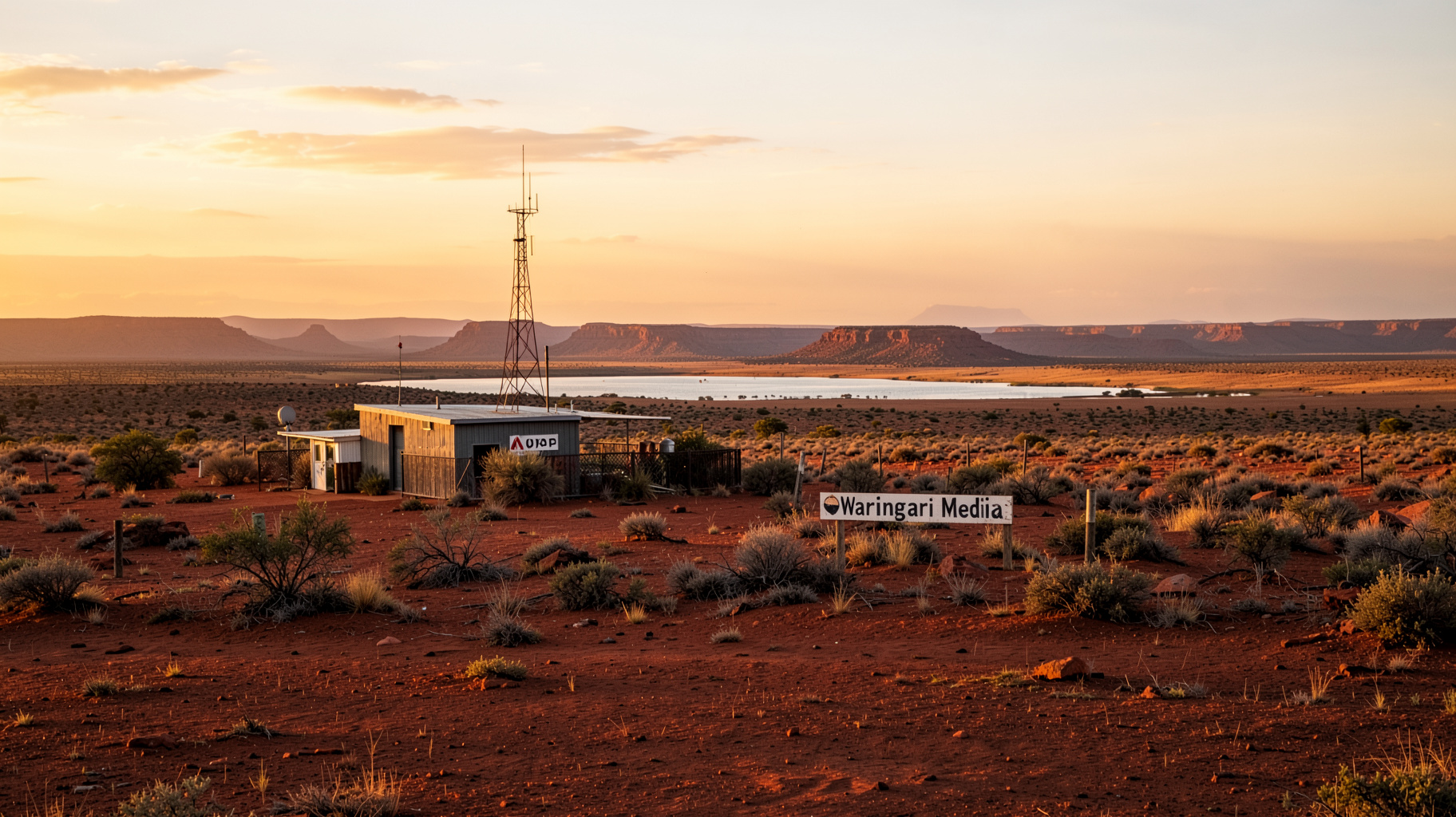
Waringarri Radio started with one hour of airtime a week, broadcast out of a mobile caravan studio, and it took another six years before the station earned its own frequency. That patience turned into a lasting institution: Waringarri Media is now Western Australia's oldest Aboriginal community radio station, still broadcasting from Kununurra on Miriwoong country in the state's far northeast.
Built From Local Pressure, Not a Government Plan
The station's origins trace to the early 1980s, when local pressure for an information and media service appropriate to Aboriginal community needs pushed the project into existence. Wayne Bynder became the first Aboriginal Broadcaster-Manager to lead it, with Dot West continuing the work from 1989. The first broadcast went to air on 9 December 1987, a single weekly hour on ABC Regional Radio out of a mobile caravan studio, a modest beginning for what would eventually become a model other Kimberley communities replicated for their own stations.
From Caravan to Callsign
Growth came in stages. A self-contained demountable studio went up on Speargrass Road in mid-1989, followed by a proper office building in 1990, officially opened on 26 June that year. Tony Walker, seconded from ABC Darwin in early 1992, took over as station manager specifically to secure a transmitter and push through community radio licensing. The community broadcasting licence came through in October 1992, and on 1 September 1993 the station began full broadcasting under its own callsign, 6WR, on 693AM, with an official opening ceremony held on 22 October 1993, nearly six years after that first single hour on air.
300 Kilometres of Red Dirt and Radio Waves
Today the station's 693AM signal, alongside 102.1FM, reaches roughly 300 kilometres out from Kununurra, a town of about 5,500 people built in 1961 to service the Ord River Irrigation Scheme on Miriwoong and Gajirrabeng country. That range carries the signal to Wyndham, Warmun, Oombulgurri, El Questro, Home Valley, Diggers Rest, Argyle and Timber Creek, well across the Western Australia and Northern Territory border into remote grazing stations and outback communities that have few other local information sources. For a region this size and this sparsely populated, a single community station covering that footprint functions as essential infrastructure rather than just entertainment.
Training and Identity, Not Just Airtime
Beyond programming, the station's stated objectives center on reinforcing Indigenous cultural identity, building trust between Aboriginal people and the wider community, and providing training and employment pathways for Aboriginal broadcasters. That mission shows up in the schedule itself, a mix of morning talk, news, country and Indigenous music, gospel programming, and specialty segments on health, legal advice and arts and culture, largely funded through the National Indigenous Australians Agency alongside the Community Broadcasting Foundation.
Still the Model It Helped Create
Waringarri Media spent the years after the COVID-19 pandemic rebuilding under new management with a refreshed website and multimedia presence, but the core of what it does has not changed since that first hour of borrowed airtime in 1987. It remains the station that proved a community-driven Aboriginal broadcaster could work in the East Kimberley, a template the rest of the Kimberley's Indigenous radio stations followed once Waringarri showed it was possible.