
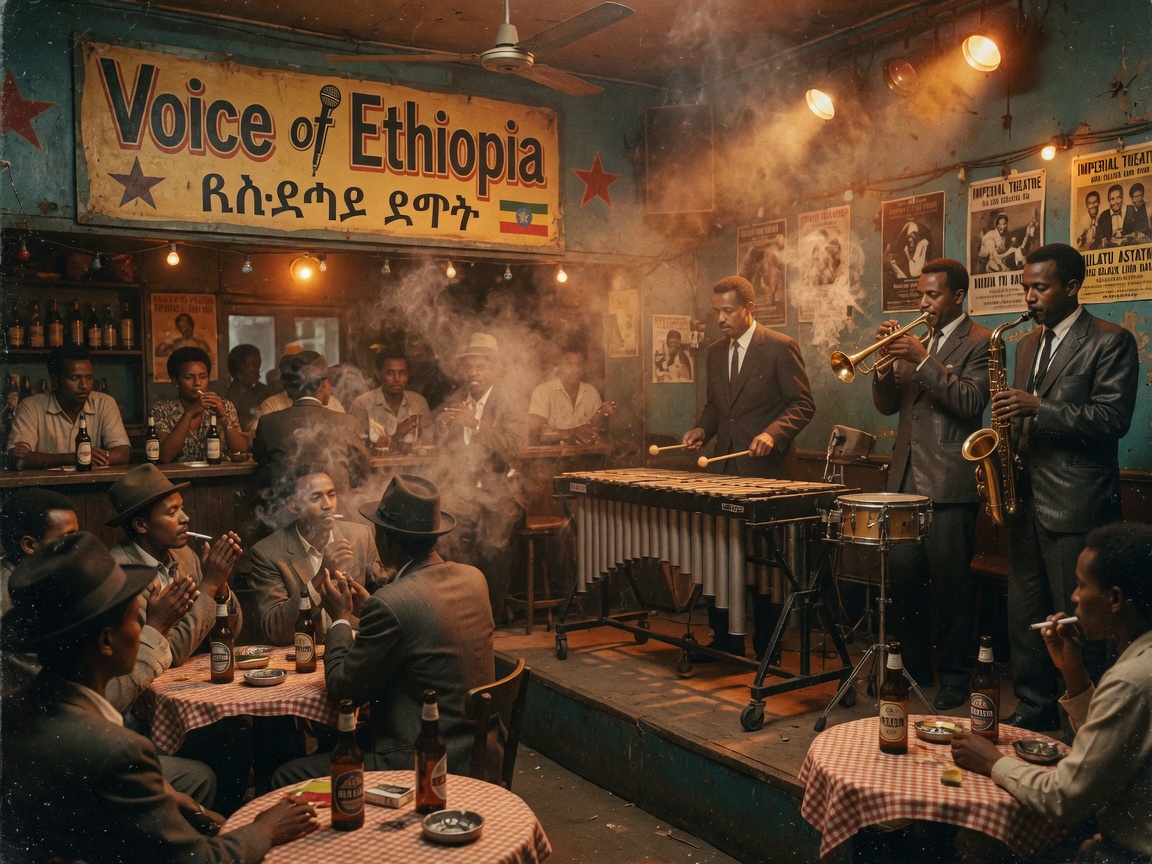
Voice of Ethiopia broadcasts current affairs, radio dramas, and music in Amharic, aimed at Ethiopians both at home and across the diaspora. A recurring description of its music catalogue is that much of it sounds strikingly similar to blues and jazz, according to a station overview from AllAboutEthio, which is not a coincidence so much as the product of a specific musical system that predates jazz by centuries and eventually collided with it directly.
A pentatonic system that just happens to sound like jazz
Ethiopian traditional music is built on qenet, a set of pentatonic modal structures that underpin everything from Ethiopian Orthodox liturgical chant to secular folk songs, according to a history of the genre from The Sound Atlas. The modes carry their own names and moods, tizita for something minor-tinged and nostalgic, along with bati, ambassel, and anchihoye, each functioning as a distinct emotional palette long before any Ethiopian musician had heard American jazz.
When Addis Ababa built its own jazz age
Those two systems formally met in the late 1960s. Mulatu Astatke, who had studied in London, New York, and at Boston's Berklee College of Music, returned to Ethiopia and began adapting qenet scales to jazz harmony, building arrangements around vibraphone and organ textures that became the foundation of Ethio-jazz. He did not do it alone. Vocalists Tilahun Gessesse, Mahmoud Ahmed, and Alemayehu Eshete, along with bands like Hailu Mergia's Walias Band, turned Addis Ababa's hotels and nightclubs into a genuine scene, with bands playing nonstop to meet demand during what is now remembered as Ethiopia's musical Golden Age. It ended abruptly in 1974, when the Derg regime's coup brought censorship, curfews, and the closure of recording companies, scattering many of the era's musicians to North America and Europe.
A sound that found a second audience decades later
Astatke's music, and Ethio-jazz more broadly, found new international attention after being featured in Jim Jarmusch's 2005 film Broken Flowers, introducing a genre built on centuries-old scales to an entirely new audience of jazz listeners who had never heard qenet by name. That is the same overlap Voice of Ethiopia's own catalogue keeps producing for its listeners today, music that sounds like it belongs to the American jazz tradition while actually descending from something considerably older.