
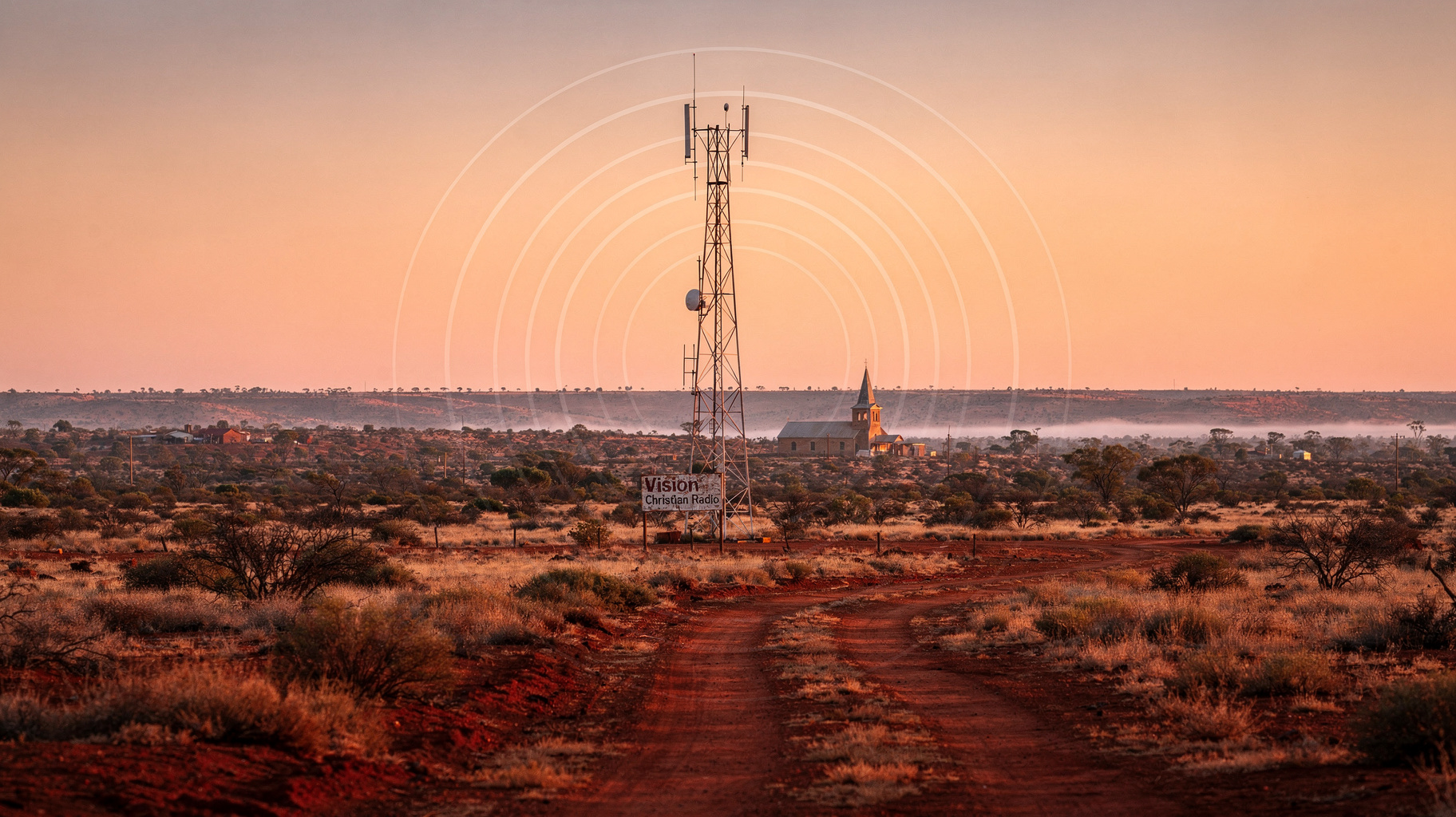
Vision Christian Radio does not run on a handful of powerful signals the way most national networks do. As of 2023, the Australian Communications and Media Authority counted 875 separate radio transmitters carrying its programming across every mainland state, a single national feed of Christian music, teaching and talkback stitched together from hundreds of small repeaters reaching over 800 towns, suburbs and cities most listeners have never had reason to think about.
Six Believers in a Room, 1988
The network traces back to December 7, 1988, when six believers led by Hal Short established what became UCB Australia, part of United Christian Broadcasters International, with the stated goal of taking the gospel "to every corner of Australia" through media, according to an account of the organization's 35th anniversary. For its first decade, under managing director Warren Rout, UCB Australia worked to help establish Christian community radio stations in around 30 cities and towns along the east coast rather than building its own network outright.
From One Transmitter to Hundreds
The station itself launched as Vision FM on February 1, 1999, broadcasting from a single transmitter in Beaudesert, Queensland. Growth from there was fast by any radio industry standard: roughly 40 transmission sites by 2001, 156 by 2004, expanding further through acquired narrowcast licenses in Western Sydney, Victoria and Western Australia, per Wikipedia's account of the network's build-out. That repeater-by-repeater strategy, rather than a handful of high-power regional signals, is exactly how the network eventually reached 875 transmitters spanning AM, FM, satellite VAST and DAB+ digital radio in Brisbane, Melbourne, Sydney and Perth.
A Family of Stations Under One Roof
Vision Christian Media, the name adopted in 2015, now operates from a hub in Springwood, Brisbane, and runs more than just the flagship station. V180 launched in October 2015 as a youth-focused spinoff on 87.6 FM in St George, Queensland, later rebranded in 2022, while Vision Kids arrived in 2023 as a streaming-only children's station and Vision Worship followed in 2025 as a dedicated music stream, each one splitting off a slice of the main network's audience into its own format.
Community-Funded, Community-Built
The network's growth has leaned heavily on listener support rather than commercial advertising revenue, most visibly through its "Visionathon" fundraising appeals. One recent appeal raised 2.3 million dollars, a result CEO Phil Edwards described as a "mammoth miracle," reflecting a funding model built on the same grassroots base that helped the network grow one transmitter at a time since 1999.
Scale Without the Spotlight
Few Australian radio networks of comparable size operate this far outside the mainstream conversation. Vision Christian Radio is not chasing ratings against commercial FM giants in Sydney or Melbourne, it is quietly running one of the country's largest transmitter footprints, built repeater by repeater into small towns that bigger networks often skip entirely.