
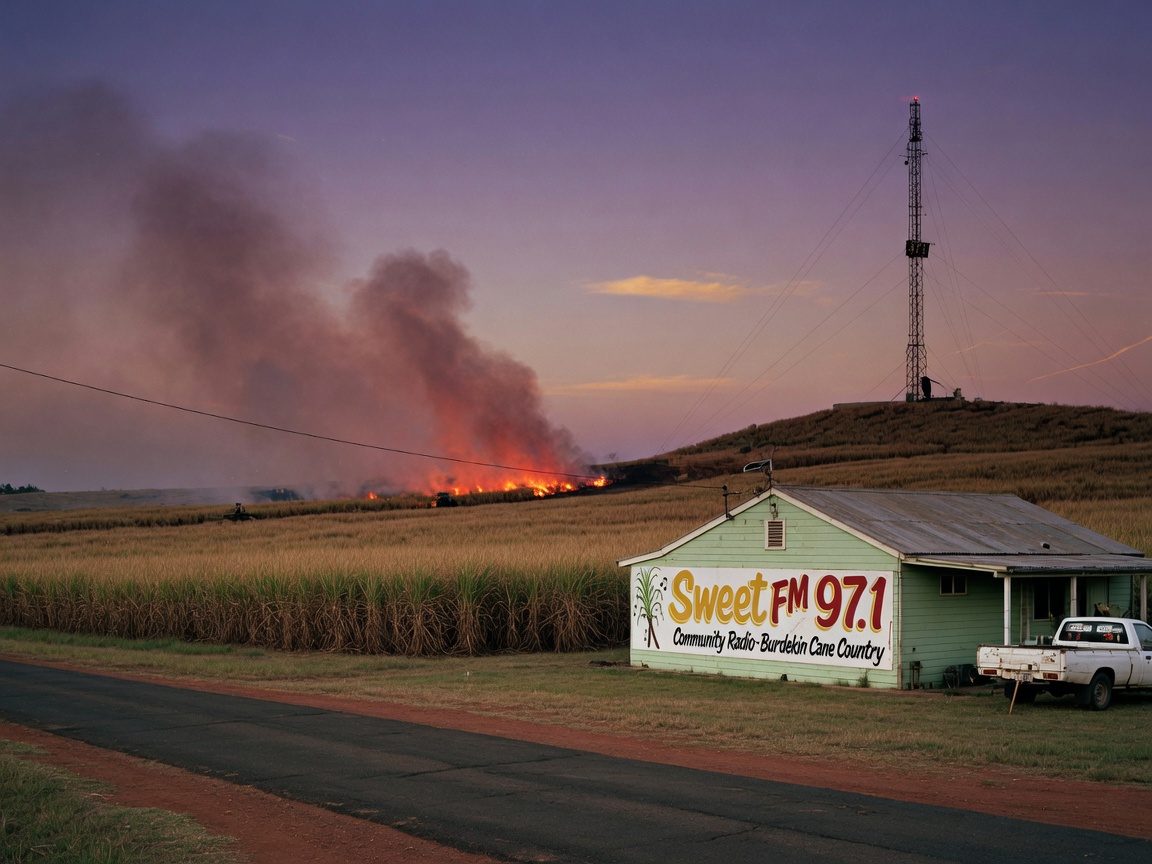
Sweet FM went to air on September 28, 1999, broadcasting from a studio inside the old Home Hill Court House Building on Eighth Avenue, with a transmitter mounted on Mt Inkerman to cover the Burdekin Shire in North Queensland, according to the station's own history page. More than two decades later it still runs the same way it started: entirely on volunteers, entirely community-owned, and entirely local.
The Burdekin is not a typical radio market. Twin towns Ayr and Home Hill sit either side of the Burdekin River delta, connected by the Burdekin Bridge, in a district that produces around 1.25 million tonnes of raw sugar a year and is still known as the sugar capital of Australia. Sweet FM's name is not a coincidence: it is a station built for, and largely by, a farming community whose entire calendar still turns around a cane crushing season lit up at night by controlled cane-fire burns.
An 80/20 station run by whoever shows up to present
Sweet FM operates on what it calls an 80/20 ratio, roughly eighty percent music to twenty percent talk, but the more distinctive detail is who decides what plays. Each volunteer presenter chooses their own program's music within the station's guidelines, so the schedule ends up as a patchwork of individual taste rather than a single centrally programmed playlist. One recurring segment, Burdekin Nostalgia, airs Monday mornings at 10 with presenter Glenis Cislowski digging into historical stories and archival photographs from the district's past, a format only a genuinely local, volunteer-run station tends to bother making room for.
The station that stays on air when the cyclones hit
North Queensland's cyclone season has repeatedly turned Sweet FM from a music station into essential infrastructure. The station stayed live through Cyclone Anthony and Cyclone Yasi in 2011, Cyclone Debbie in 2017, and Cyclone Kirrily in 2024, along with the flooding that followed each event, keeping Burdekin residents updated with current information when it mattered most. That track record is the kind of thing a commercial station covering a much bigger, more profitable market rarely has the local commitment, or the reason, to build. For a shire built around sugarcane and river flats prone to flooding, a community station willing to stay on air through the worst weather of the year is not a nice extra. It is the reason Sweet FM has held its audience's trust for a quarter of a century.