
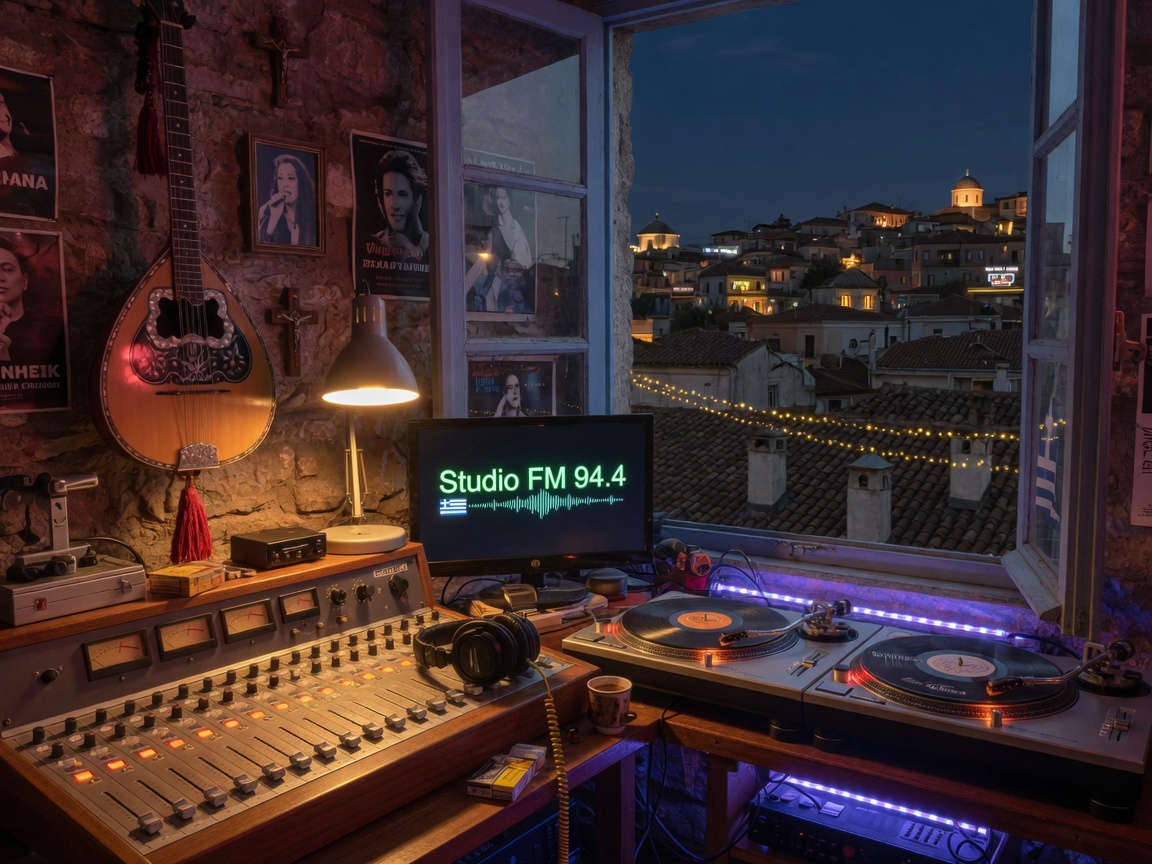
Studio FM 94.4 broadcasts out of Trikala, a city in the Thessaly region of central Greece that carries an outsized reputation in Greek music history. Officially the station wears a folk and traditional tag, but what actually comes out of the stream is a steady rotation of deep house and electronic dance mixes, a mismatch that says something interesting about how small local stations often drift from their own labels.
Trikala's real claim to musical fame
Trikala is the birthplace of Vassilis Tsitsanis, widely regarded as one of the most important songwriters in Greek music history and a defining figure of rebetiko, the genre often described as Greece's answer to the blues. Composer Mikis Theodorakis once said "Tsitsanis' songs are Greece itself," according to a profile of the musician from To Vima. Though Tsitsanis left for Athens at 25 and later worked in Thessaloniki, he kept a lifelong bond with Trikala and personally proposed the idea for a rebetiko museum there during a 1980 concert in his hometown, an idea that took 45 years to become real: the Tsitsanis Museum finally opened in summer 2025 inside a restored former prison next to an Ottoman bathhouse, with his bouzouki, handwritten sheet music, and personal artifacts on permanent display.
A station tagged for a tradition it mostly skips
Against that backdrop, Studio FM 94.4 carries genre tags for folk, Greek, and traditional music, and its own station description promises "traditional Greek tunes" alongside "modern interpretations of classic songs." What actually plays leans hard the other way. Track logs compiled by Radiostar show a rotation dominated by deep house sets and remix compilations, including multiple mixes from an artist going by Gentleman, alongside contemporary dance edits like a Dj Dark and MD remix of Michael Jackson's "Billie Jean" and an Afro house sunset mix. It is programming built for a late-night dance floor, not a folk revival.
A small station's honest identity crisis
That gap is not unusual for a local station running on a modest fanbase rather than a corporate playlist. General web listings still describe Studio FM as an outgrowth of an earlier electronic music project in Trikala, and its rotation reflects that lineage more than the folk tag attached to it in most directories. For a city whose musical identity is genuinely rooted in Tsitsanis and rebetiko, a local station leaning toward deep house instead is less a contradiction than a reminder that Trikala's current listeners, like most small-city audiences, want the same house and dance tracks circulating everywhere else, whatever label ends up on the station.