
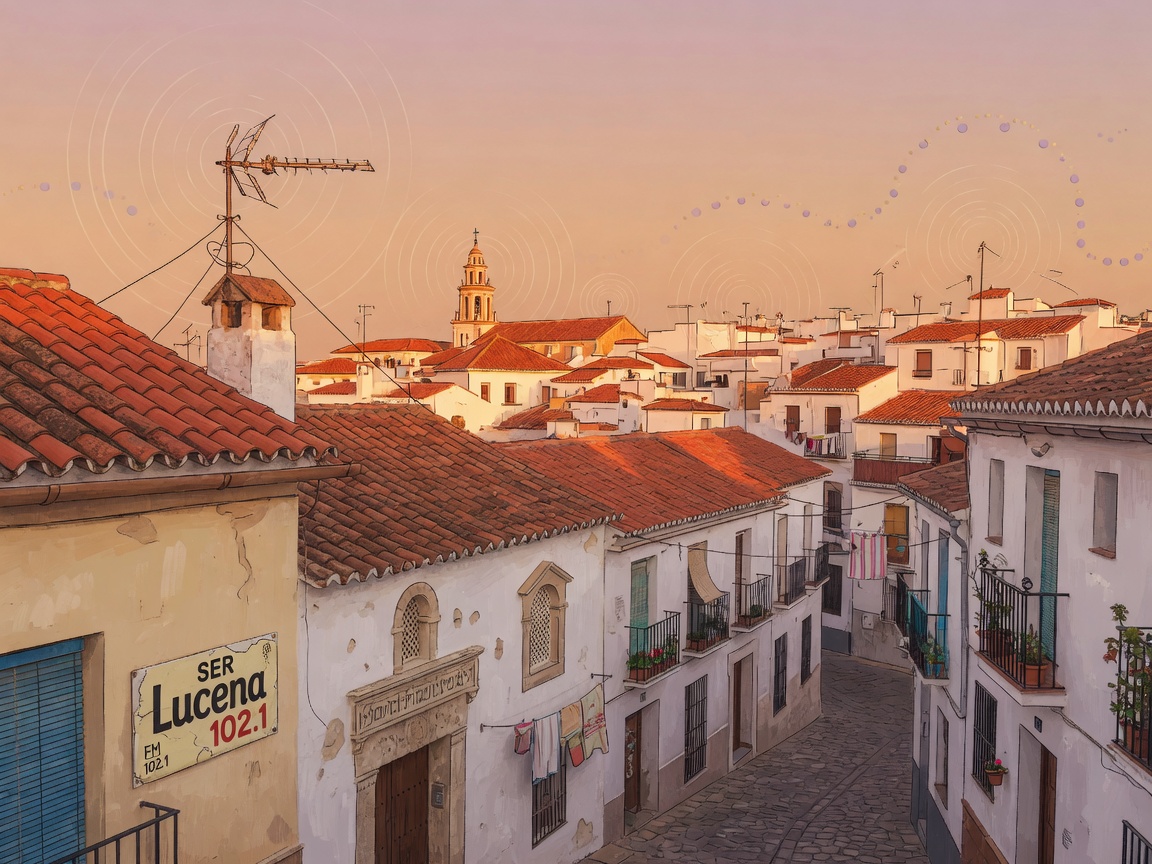
SER Lucena broadcasts under the banner of Cadena SER, and that affiliation carries real weight in Spain. Cadena SER traces its roots back to 1924, when Radio Barcelona first went on air, making it, in its own words, "la emisora decana de España," the country's oldest broadcasting station, according to the history of Cadena SER on Wikipedia. What began as Unión Radio survived a civil war, a name change to SER under the Franco regime, and eventual acquisition by media group PRISA, growing into Spain's most listened to commercial radio network along the way.
SER Lucena operates as part of the SER Andalucía Centro grouping, broadcasting on the FM dial in Lucena, in the province of Córdoba, blending Cadena SER's national news and talk programming with dedicated local coverage for the town and its surrounding countryside. It is a familiar model in Spanish radio: a national brand with a century of institutional credibility, localized down to the level of a single Andalusian town.
Broadcasting from the Pearl of Sefarad
Lucena itself carries a history that predates radio by nearly a thousand years. Between the 9th and 12th centuries, it was one of the most important Jewish communities in Al-Andalus, earning the nickname "the Pearl of Sefarad" for the intellectual life that flourished within its walls, according to the Red de Juderías de España. The town's Talmudic academy drew philosophers, poets, and physicians, among them figures as significant as Maimonides, and its Jewish community grew further as refugees fled persecution in Córdoba and Granada during the 11th century. That golden age ended abruptly in 1146 when the Almohads invaded, scattering the community whose legacy is now preserved in one of the largest excavated Jewish cemeteries on the Iberian Peninsula.
A local radio station is a small thing set against that kind of history, but it plays a similar role on a smaller scale: keeping the town's daily life connected and recorded. SER Lucena carries forward a network built during Spain's earliest broadcasting era into a place that has been recording its own history for over a thousand years.