
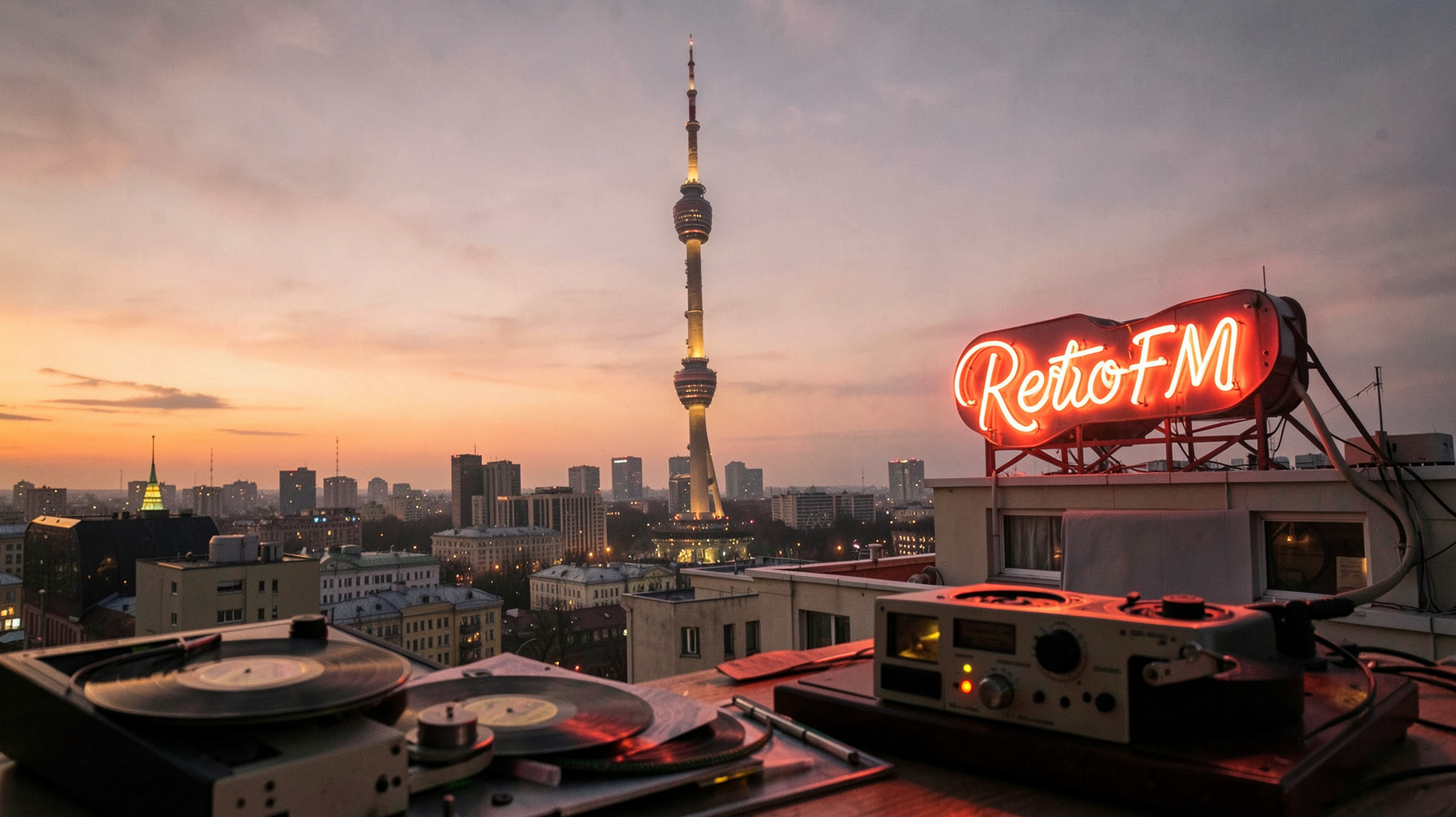
RetroFM didn't launch as its own station. It started as a segment, five-hour blocks called "Radio Retro Presents" that aired within Moscow's Radio-1 Ostankino starting January 13, 1995, testing whether a dedicated run of 70s, 80s, and 90s hits could hold an audience on its own. It clearly could. Within a year, that segment had grown into an independent station in its own right.
From a Block of Programming to a Standalone Station
The station's official independent launch came on February 14, 1996, under the name Radio Retro, before it took the name RetroFM on May 29, 2003, according to a history of the station. That evolution, from a scheduled programming block to a fully independent brand, is the kind of growth path that only makes sense if the original concept was already resonating before it had its own frequency, proof that Moscow listeners wanted more of the format than a few hours a day could deliver.
Part of Russia's Largest Commercial Radio Holding
RetroFM now operates under Европейская Медиа Группа, the European Media Group, a Russian broadcasting holding company that also runs Europa Plus, Dorozhnoe Radio, Radio 7, and several other national networks. Within that portfolio, RetroFM has built a genuinely large following, reaching more than eight million listeners daily with a format built around Soviet, Russian, and international hits from the 1970s through the 1990s aimed primarily at listeners between 35 and 65.
Thirty Years of the Same Three Decades
What's notable about RetroFM's format is how narrow and consistent it has stayed since that first five-hour block in 1995. The station has never chased a younger demographic by widening its playlist into the 2000s or 2010s; it has stuck to the same three-decade window of music for three decades of its own existence, betting that the audience for that specific stretch of music would remain loyal rather than needing constant refreshing.
A Segment That Outgrew Its Slot
Few radio stations can trace their origin back to a single programming block on someone else's frequency, but RetroFM did exactly that, and the format proved durable enough to carry it from a five-hour Ostankino slot to one of the largest retro-format stations in Russia.