
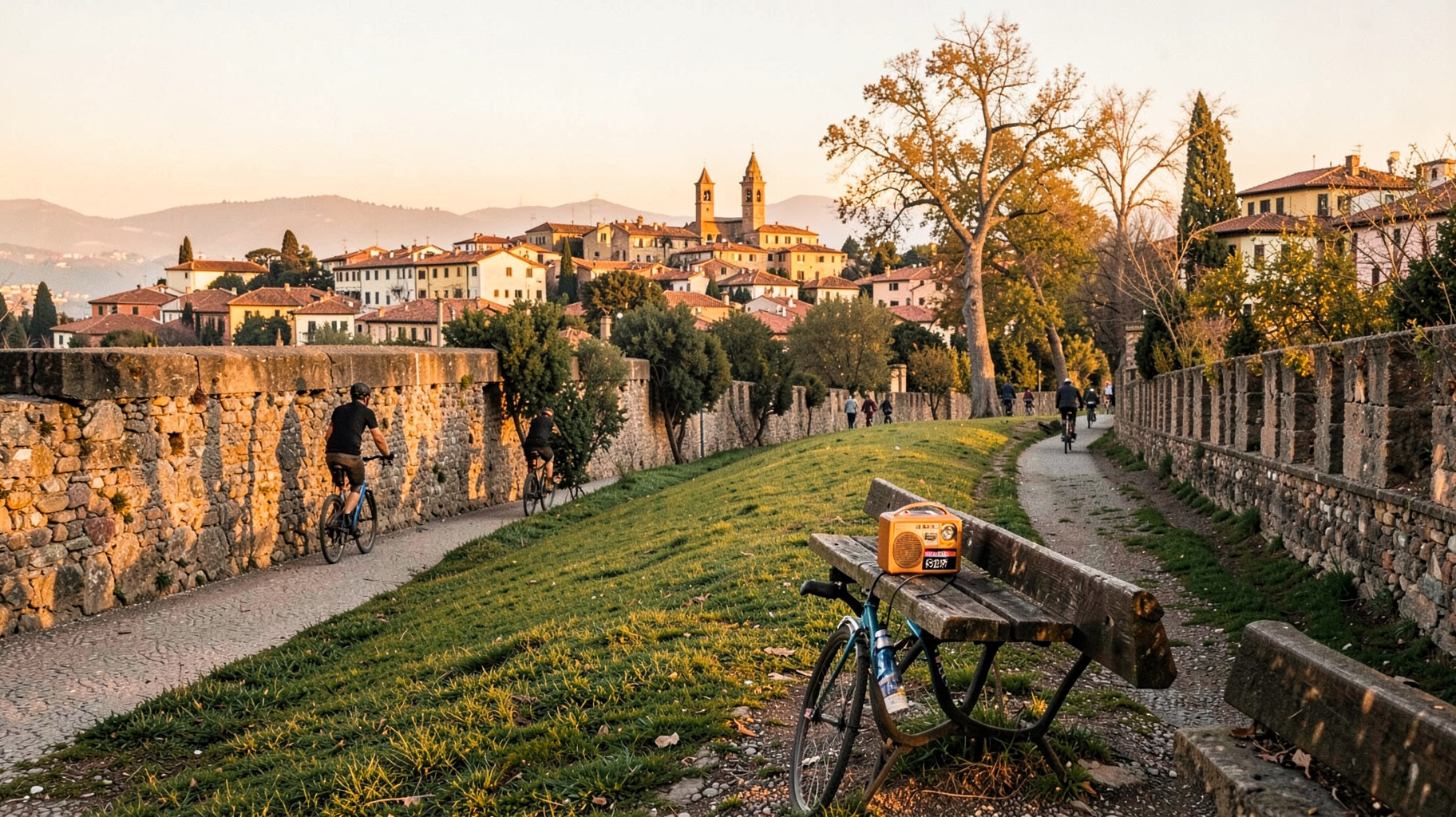
Radio Star 92e5 plays classics from the '70s through the 2000s out of Lucca, a Tuscan city better known for the composer it produced than for its FM dial. The station has been broadcasting from behind Lucca's Renaissance walls since 1984, longer than most of the decades it now plays music from.
Forty Years on the Lucca Plain
RADIOSTAR was founded in Lucca in 1984 and now broadcasts on FM 92.7 and 102.2, streaming online and on DAB+, according to the station's own history page. Its signal covers the Lucca plain and stretches into the provinces of Pistoia, Prato, Pisa and Florence, with the 102.2 frequency reaching further into the Mediavalle and Garfagnana areas and, on DAB+, as far as Siena, Grosseto, Livorno and parts of Umbria. The station runs live morning and afternoon programming and keeps an active calendar of concerts, expos and public square events, backed by mobile studio and staging equipment that lets it broadcast from commercial venues and outdoor festivals alike.
A City Built Inside Its Own Walls
Lucca's most recognizable feature has nothing to do with radio. The city is ringed by a 16th-century wall roughly 12 meters thick and 25 meters high, one of the only city walls in Italy that remains fully walkable, cyclable and drivable along its entire perimeter, according to My Travel in Tuscany. That ring of ramparts has kept Lucca's historic core largely intact while the modern city grew up around it, giving Radio Star's coverage area a genuinely walled town at its center.
The Town That Gave Opera Its Voice
Lucca is also the birthplace of Giacomo Puccini, born there in 1858 into a family that had served as musical directors of the Cathedral of San Martino since 1719. His childhood home is now the Puccini Museum, and the nearby church of San Giovanni hosts recitals of his arias nearly every evening of the year, making Lucca one of the few cities in the world where a visitor can reliably hear its native composer's work performed nightly. The city extends that musical identity every July with the Lucca Summer Festival, one of Tuscany's biggest music events, drawing international acts to Piazza Napoleone.
A Hits Station in an Opera Town
Radio Star's format sits at the opposite end of the musical spectrum from Puccini's arias, built instead around four decades of pop and chart hits for a broad regional audience. But the station has outlasted plenty of trends since 1984, broadcasting from a city that has spent nearly two centuries proving it can hold onto both a 19th-century composer's legacy and a modern hits station without either one crowding out the other.