
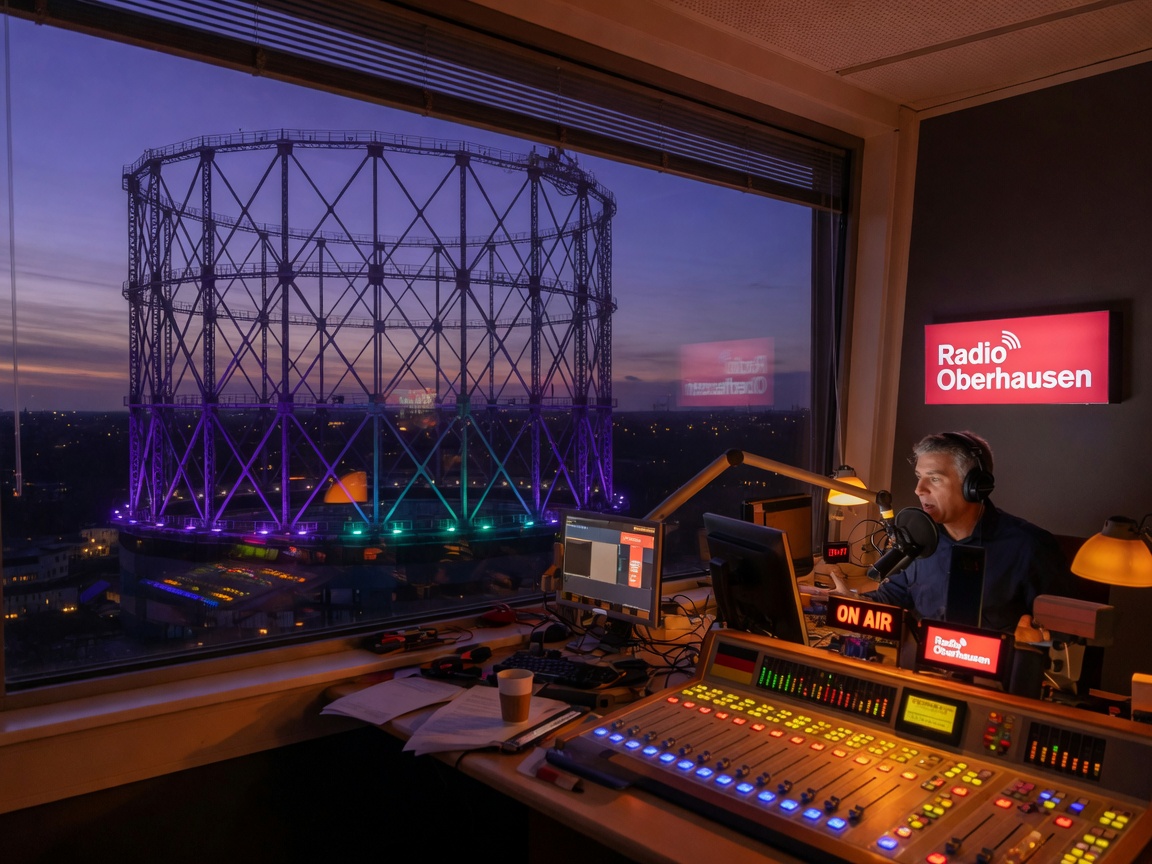
Before Radio Oberhausen existed on its own, it was half of a shared station. Until August 5, 2007, Oberhausen and the neighboring city of Mülheim an der Ruhr split airtime on a single local broadcaster called Antenne Ruhr. The next morning that arrangement ended for good, in what was the first split of a local station in North Rhine-Westphalia's history, and 106.2 Radio Oberhausen signed on with a city entirely to itself.
A Frequency Finally Its Own
The station broadcast under the name 106.2 Radio Oberhausen for its first few years, tied directly to the FM frequency listeners used to find it. That changed on January 11, 2010, when a wider relaunch of North Rhine-Westphalia's local radio stations dropped the number from the name, leaving the simpler Radio Oberhausen brand that still broadcasts from a transmitter on Essener Straße today.
A City Built on Steel, Now Heard on the Radio
Oberhausen spent most of the 20th century as a coal and steel town before reinventing itself around retail and leisure, most visibly through the giant CentrO shopping and entertainment complex and the retired Gasometer gas holder turned exhibition hall that now anchors the skyline. Radio Oberhausen's adult contemporary format, mixing current hits with a roughly 70:30 balance of music to talk, fits a city that has spent decades rebuilding its identity while staying proudly local.
More Than One Way to Tune In
Beyond the main frequency, the station runs companion streams like Radio Oberhausen Lounge and an 80s-focused channel, letting listeners pick a mood without leaving the Radio Oberhausen name behind. It's a small-scale version of the same idea bigger German networks use, giving a single-city station room to serve more than one kind of listener at once.
Local Radio, Still Doing Local Things
With roughly 32,000 daily listeners, Radio Oberhausen stays firmly in service of its own city, mixing local news and events into the schedule rather than chasing a wider regional audience. In a media landscape increasingly dominated by national and streaming-first brands, that kind of unglamorous, city-specific commitment is exactly what keeps a station like this relevant to the people who actually live there.