
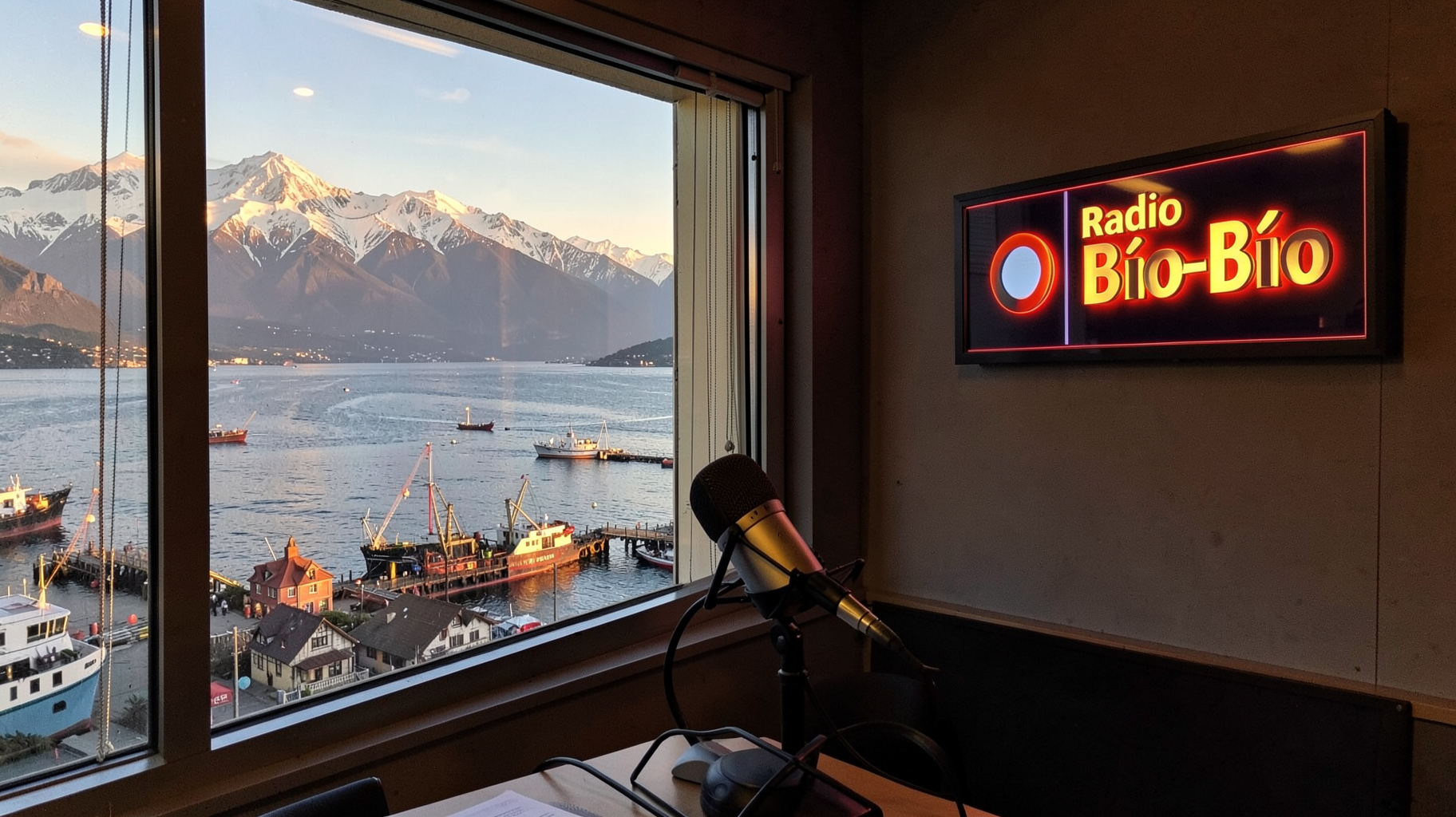
Chile's radio landscape is full of stations tied to a political party, a church, or a business conglomerate. Radio Bío-Bío has spent six decades building a reputation for being none of those things, and its Puerto Montt frequency is one outpost in what has grown into the country's largest independent news network.
Born in Concepción, Built to Stay Independent
Radio Bío-Bío launched on April 24, 1966, in the city of Concepción, taking its name from the Bío-Bío River that runs through the region, according to the station's Wikipedia entry. From the start it built its programming around news, sports, music, economics, and international affairs rather than a single format, and that broad news mission has defined it ever since. What sets the network apart in Chile's media landscape is a claim few Chilean broadcasters can make: it remains the country's only major station not affiliated with any political, religious, or economic group, a position it has held onto through decades of ownership consolidation across the industry.
From One City to the Length of the Country
The network stayed close to home for its first quarter century before expanding aggressively in the 1990s, opening stations in Temuco, Osorno, and Puerto Montt in southern Chile before adding a Santiago outlet in 1997. That southern push is what eventually brought Radio Bío-Bío to Puerto Montt, extending the network's reach well beyond its Concepción birthplace. The expansion didn't stop at Chile's more populous cities either. In 1995, the network launched Bío Bío Lonquimay in an isolated corner of the Araucanía Region's Andes mountains to serve a largely indigenous community, a sign that the network's growth was aimed at coverage, not just market size. Today Radio Bío-Bío runs 40 frequencies stretching from Arica near the Peruvian border to Punta Arenas in the far south, giving it a footprint that touches roughly 98 percent of Chile's population.
A City Built by Settlers, Now a Gateway South
Puerto Montt itself carries a distinct history within Chile. The city was founded on February 12, 1853, under President Manuel Montt's government-sponsored German colonization program, led by Vicente Pérez Rosales to develop Chile's southern frontier. That settlement history is still visible in the city's architecture and local traditions today. As capital of the Los Lagos Region, Puerto Montt sits on the Reloncaví Sound and functions as the main maritime gateway to Chilean Patagonia and the Chiloé Archipelago, a jumping-off point for travelers and cargo heading into some of the country's most remote territory. A station built on national and international news coverage has a natural role to play in a city that sits at that particular crossroads between settled Chile and its wild south.
News First, in a Region That Needs It
For a city that serves as a logistics and transport hub for the far south, having a local outlet of Chile's largest independent news network matters in a practical way. Puerto Montt listeners get the same commitment to música y noticias, music and news, that defines every Radio Bío-Bío frequency, but filtered through a station positioned to cover a region where weather, ferry schedules, and southern route conditions carry real weight for daily life. It's local news delivered by a network built explicitly to stay accountable to no one but its listeners.