
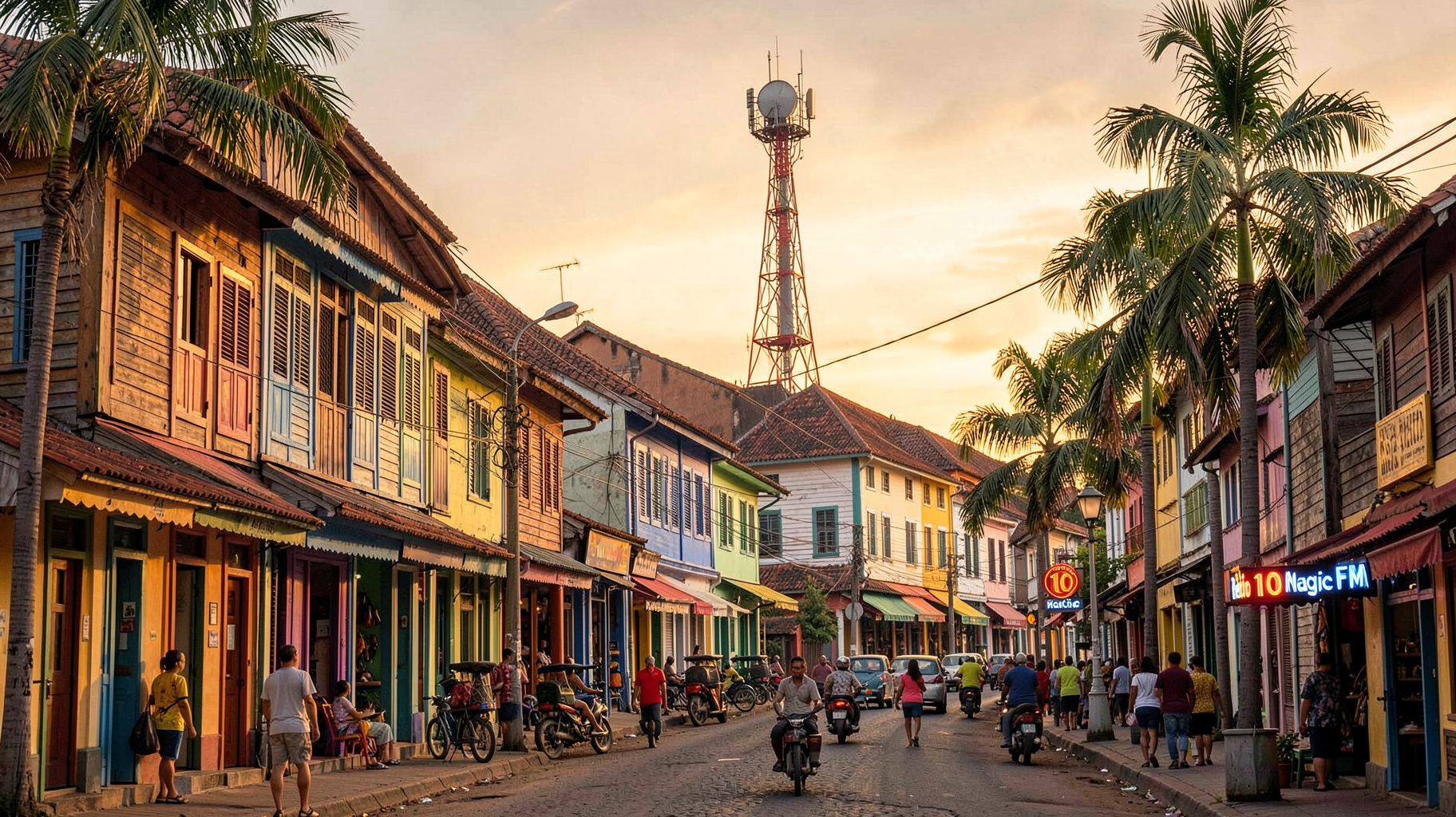
Paramaribo does not fit neatly into any single cultural box, and that is precisely its identity. Founded by the Dutch in 1613 and shaped over centuries by African, Indian, Javanese, Indigenous, Chinese and Lebanese communities brought together through a difficult colonial plantation history, the city's historic inner city earned UNESCO World Heritage status in 2002 for the way its wooden Dutch colonial architecture absorbed and reflected that mix. Mosques, Hindu temples, synagogues and churches sit close together here, a rare visible marker of how many traditions actually share the same streets. Radio 10 Magic FM broadcasts from right inside that layered city.
The station first went on air on December 10, 1996, the idea of owner Werner Duttenhofer Sr., who according to its recorded history built the station around a deliberately forward-looking, innovation-first concept from day one. A decade later, on its tenth anniversary in December 2006, the station rebranded with a redesign shaped by artists Ray Daal, August Bohé and Sojo Prijatno, a refresh that carried it into its second decade still under Duttenhofer's ownership.
Radio 10 reaches listeners across Paramaribo, the Nickerie district and Moengo on three separate FM frequencies, running an Adult Contemporary and Contemporary Hit Radio format that spans music from the 1960s through to current releases. That range is the whole point of the "Magic" branding, a mix pitched broadly enough to work as background music for an entire multi-generational, multi-ethnic city rather than a single demographic slice of it.
One detail stands out as a genuinely unusual point of pride: Radio 10 Magic FM was the first radio station in Suriname to broadcast the exact time using a GPS and DCF-synced computer system, a small technical milestone that speaks to that same innovation-first instinct the station was built on back in 1996.
For listeners connected to Suriname or simply curious about a small South American nation with an outsized cultural mix, Radio 10 Magic FM offers nearly three decades of continuous, wide-format broadcasting from a city that has spent four centuries learning to hold many identities at once.