
Palmós means pulse in Greek, and Palmós Kefalloniás 98.3 has spent years living up to that name, running a 24-hour stream of Greek music dedicated entirely to homegrown artists from Argostoli, the island's capital. The name carries extra weight on an island that has had to rebuild its own pulse more than once.
All Greek, All the Time
The station's format is deliberately narrow: nothing but Greek music around the clock, mixing yesterday's hits with the newest releases and positioning itself as one of the first stations to premiere new Greek songs on air. That focus sets it apart from the more genre-mixed stations common elsewhere on the Ionian Islands, giving Kefalonia a dedicated outlet for a national music scene that international listeners rarely encounter through mainstream channels.
An Island Almost Erased in a Single Morning
Kefalonia's modern identity is inseparable from the 1953 Ionian earthquake, a magnitude 7.2 quake that struck on August 12 of that year and destroyed roughly 90 percent of the island's buildings. Argostoli, Lixouri, Assos and Sami, the very towns Palmós now broadcasts into, were largely flattened, leaving 600 dead and 100,000 people homeless across the region. Only the village of Fiskardo, sitting nearly 50 kilometers from the epicenter at the island's northern tip, survived with its 18th-century Venetian houses intact. The disaster triggered a wave of emigration that permanently reshaped the island's population, a scar that still shapes how Kefalonians talk about their own history.
Music That Survived What Buildings Didn't
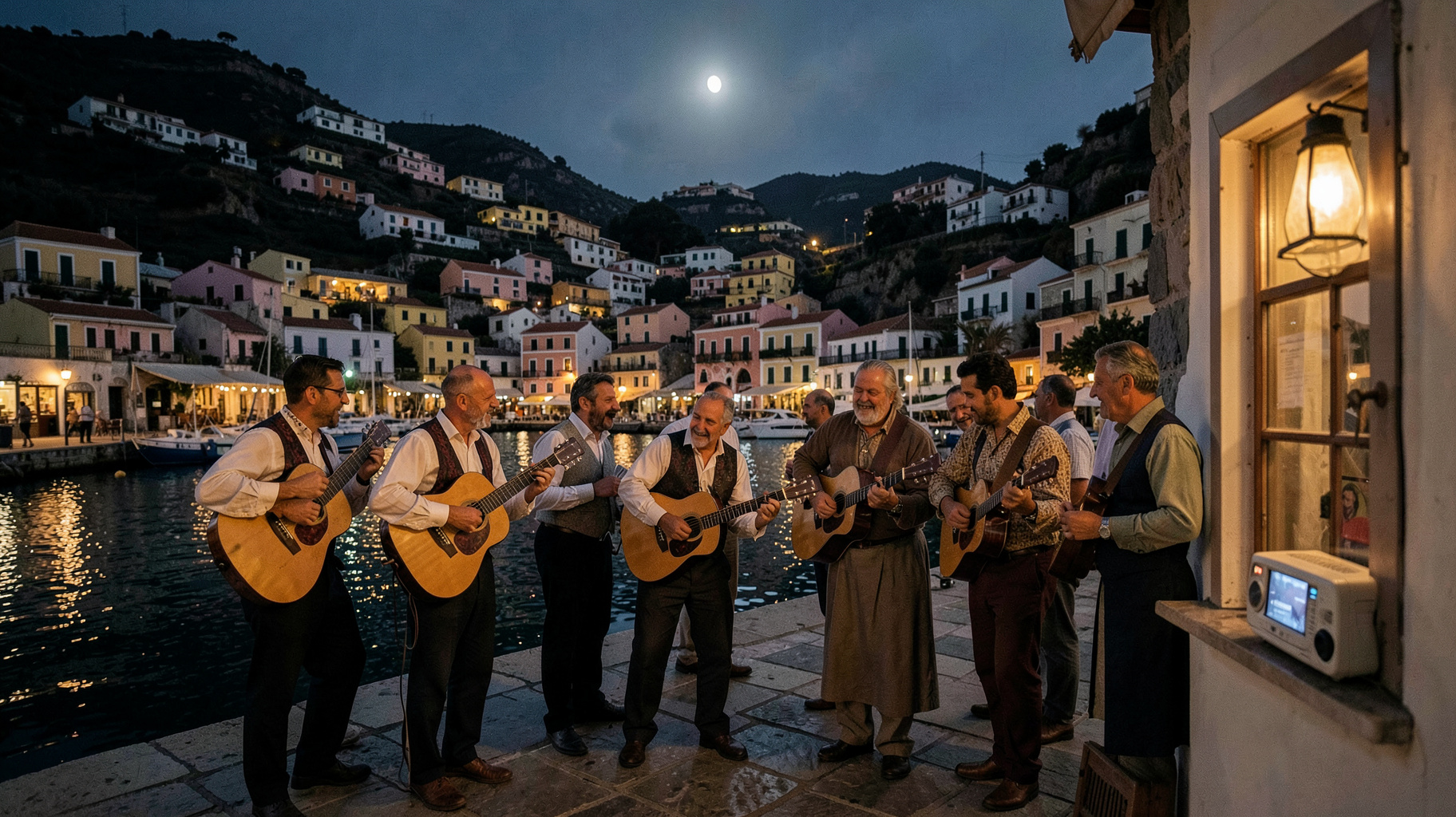
What the earthquake could not erase was Kefalonia's musical tradition. The island is the birthplace of kantada, a romantic Ionian serenade style that emerged in the early 1800s under heavy Italian influence, built around guitar-accompanied songs closer to arias and serenades than mainland Greek folk music. Lixouri, one of the towns leveled in 1953 and rebuilt afterward, remains home to some of Greece's oldest philharmonic schools, a musical infrastructure that predates the earthquake and quietly survived it through the people who kept teaching and playing after their own town had to be rebuilt from the ground up.
A Modern Signal on Ancient Ground
Palmós Kefalloniás 98.3 broadcasts into that same layered history from studios in Argostoli, a city rebuilt in reinforced concrete to strict modern seismic codes after 1953 but still carrying centuries of Venetian, Ottoman and British influence in its architecture and food. A station built entirely around Greek music fits naturally into a place where music survived the one thing that nearly took everything else.
Still Beating
Nearly seventy years after an earthquake flattened the towns it now serves, Palmós Kefalloniás 98.3 keeps its namesake promise, functioning as a genuine pulse for an island that has proven, more than once, that its culture rebuilds faster than its buildings ever could.