
Montana Public Radio started as a classroom experiment. In 1965, University of Montana journalism professor Phil Hess signed on KUFM-FM as a 10-watt training station inside the School of Journalism, a facility built to teach students broadcasting basics rather than to serve an entire state. Six decades later, that same call sign anchors a network reaching an estimated 500,000 Montanans across the western and central part of the state, one of public radio's clearer examples of a small campus project growing into essential regional infrastructure.
From 10 Watts to a Statewide Network
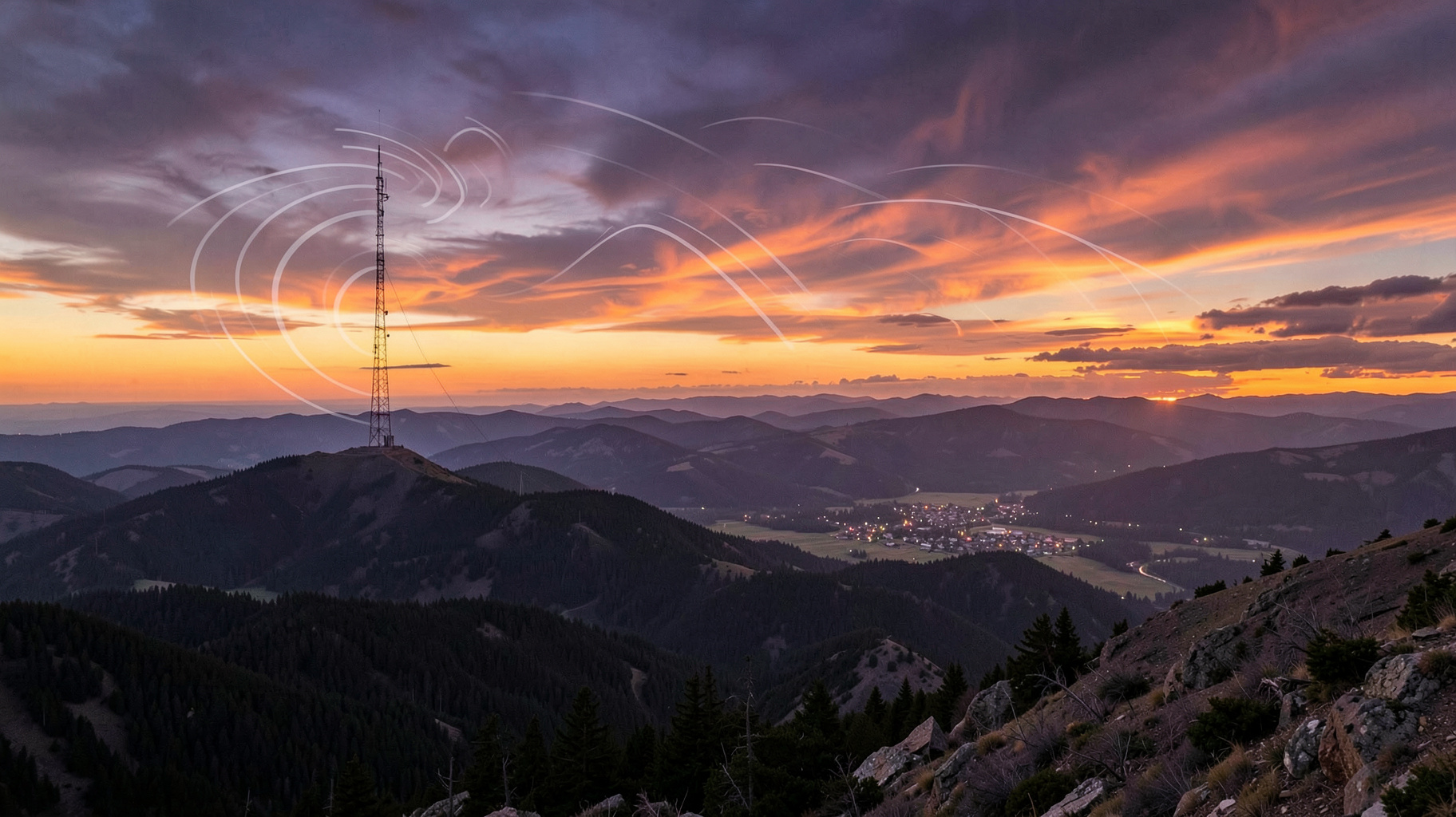
KUFM's early years were modest by design, a part-time station dependent on class schedules and student volunteers that barely carried past the University of Montana's Missoula campus. That changed fast once the funding arrived. Power jumped to 4,000 watts in 1972, the transmitter moved to Big Sky Mountain near Missoula and reached 14,500 watts by 1973, and a 1974 Corporation for Public Broadcasting grant let the station go full-time, broadcasting 18 hours a day year-round while becoming a charter member of National Public Radio that same year.
Building a Network Across Rugged Terrain
Montana's geography makes single-transmitter coverage impossible, and MTPR spent the following decades building around that reality rather than against it. Translators reached Butte, Helena, Marysville, Bigfork, Swan Lake and Whitefish through the late 1970s and 1980s, sister station KGPR signed on in Great Falls in 1984, and further transmitters activated in Kalispell, Hamilton, Butte and Helena by 1999. As recently as 2011, new transmitters in Libby and Polson closed gaps in coverage that had persisted for decades, work that continued into 2012 with improvements across the North Flathead region. The Polson transmitter, KPJH, carries founder Phil Hess's initials, a direct link back to the journalism classroom where the whole network began.
What Keeps It Running
MTPR today operates eight transmitters and five translators out of the Performing Arts and Radio-TV Building on the University of Montana campus, still university-owned nearly sixty years after Hess signed it on. About 7,000 members supply roughly 75 percent of its annual operating budget, a heavier reliance on listener support than many public broadcasters carry, reflecting both Montana's sparse commercial advertising base and a long-standing regional habit of funding the network directly.
A Rare Kind of Longevity
Few stations anywhere trace an unbroken line from a single professor's classroom project to a full regional network still carrying his initials on one of its transmitters. Montana Public Radio's growth mirrors the state it serves, wide, sparsely populated, and dependent on infrastructure built patiently over decades rather than all at once, and sixty years on it remains one of the clearest examples of what public radio can become when a community keeps investing in it.