
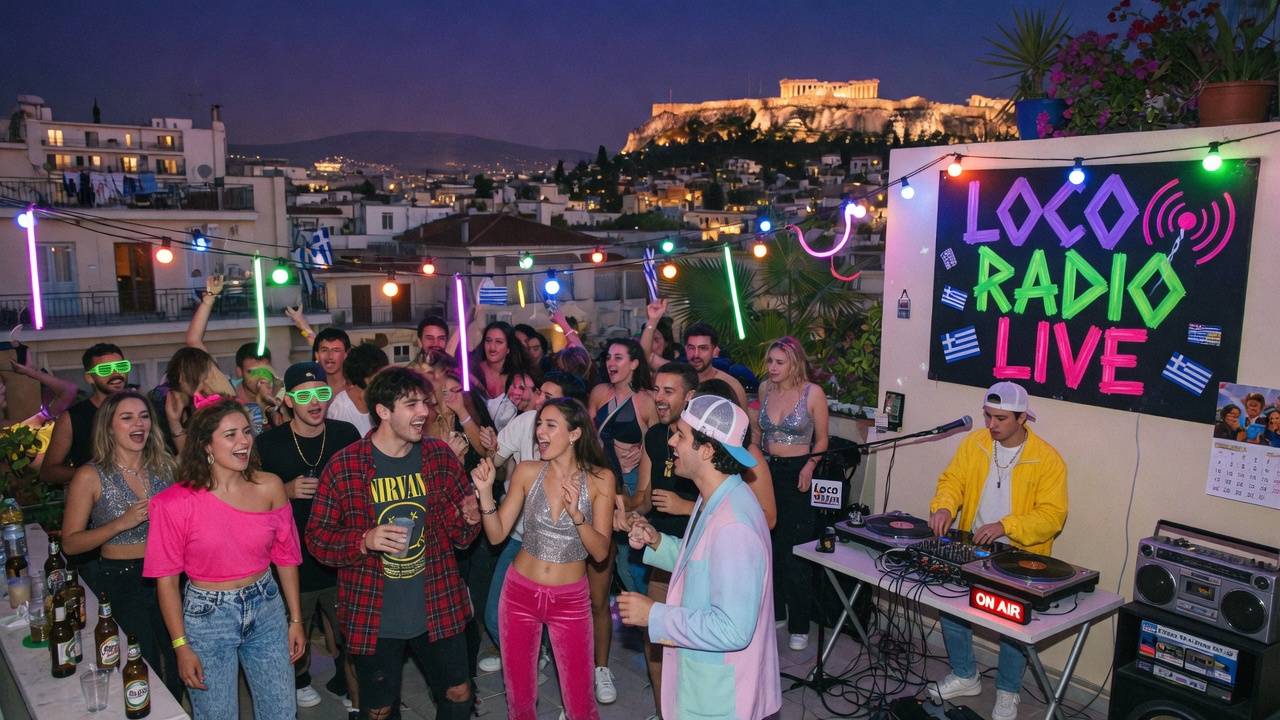
Loco Radio Live streams "90's, 00's, 10's Loco Music" around the clock from Attica, Greece, running under the tagline "Because life wants loco music." Rather than a single playlist on autopilot, the station is built around a roster of volunteer DJs, Maze, Marea, Pritanis, Mentzelos, Phat, Manos, Vernal, Stefania, Ghost, DrBart, Dimitris, and Osiris among them, each hosting themed live shows across the week.
A lineup built by its DJs, not a program director
The shows themselves lean into genre and personality rather than a uniform hits format. "Euphoria Project" and "Hip-Hop Time" sit alongside "MetaLoco," a metal-focused slot whose name plays on the station's own branding, according to the schedule listed on the station's own website. That structure, a small collective of named hosts each running their own hour rather than a single centralized playlist, is closer to community radio than to a commercial format, and the station leans into it by branding its listener base "The Loco Family" and pushing an active live chat alongside its Facebook and Instagram presence.
Independent radio's rocky recent history in Athens
Small, independently run stations like this one operate in a city with a genuinely turbulent recent radio history. In March 2001, the Greek government shut down roughly sixty of the more than ninety FM stations then broadcasting in the Athens area, officially citing frequency interference concerns tied to the new Athens International Airport, according to a history of Greek broadcasting compiled on Wikipedia. Critics at the time argued the closures conveniently favored established publishing and media groups whose own stations mostly stayed on air, and the licensing dispute dragged through Greek courts for years, with eight of the shuttered stations reopening in 2002 and more following in 2004 and 2005 after judicial orders. That fight over a crowded, contested FM dial helps explain why so much of Greece's independent and niche-format radio culture, stations built around a specific decade, genre, or volunteer DJ community rather than mass appeal, now lives online instead of fighting for scarce frequency space.
A decades-spanning format with no single era to sell
Loco Radio Live's own format, an unbroken run through the 80s, 90s, 00s, and 10s spanning dance, rock, R'n'B, metal, classic, and hip-hop, only really works as an internet station. No single FM license would comfortably hold that range, but a volunteer-run stream with a dozen hosts trading off shows can move between MetaLoco one hour and Hip-Hop Time the next without needing to justify the jump to an advertiser or a regulator, running on exactly the kind of format flexibility that Athens' old, fought-over airwaves never really allowed.