
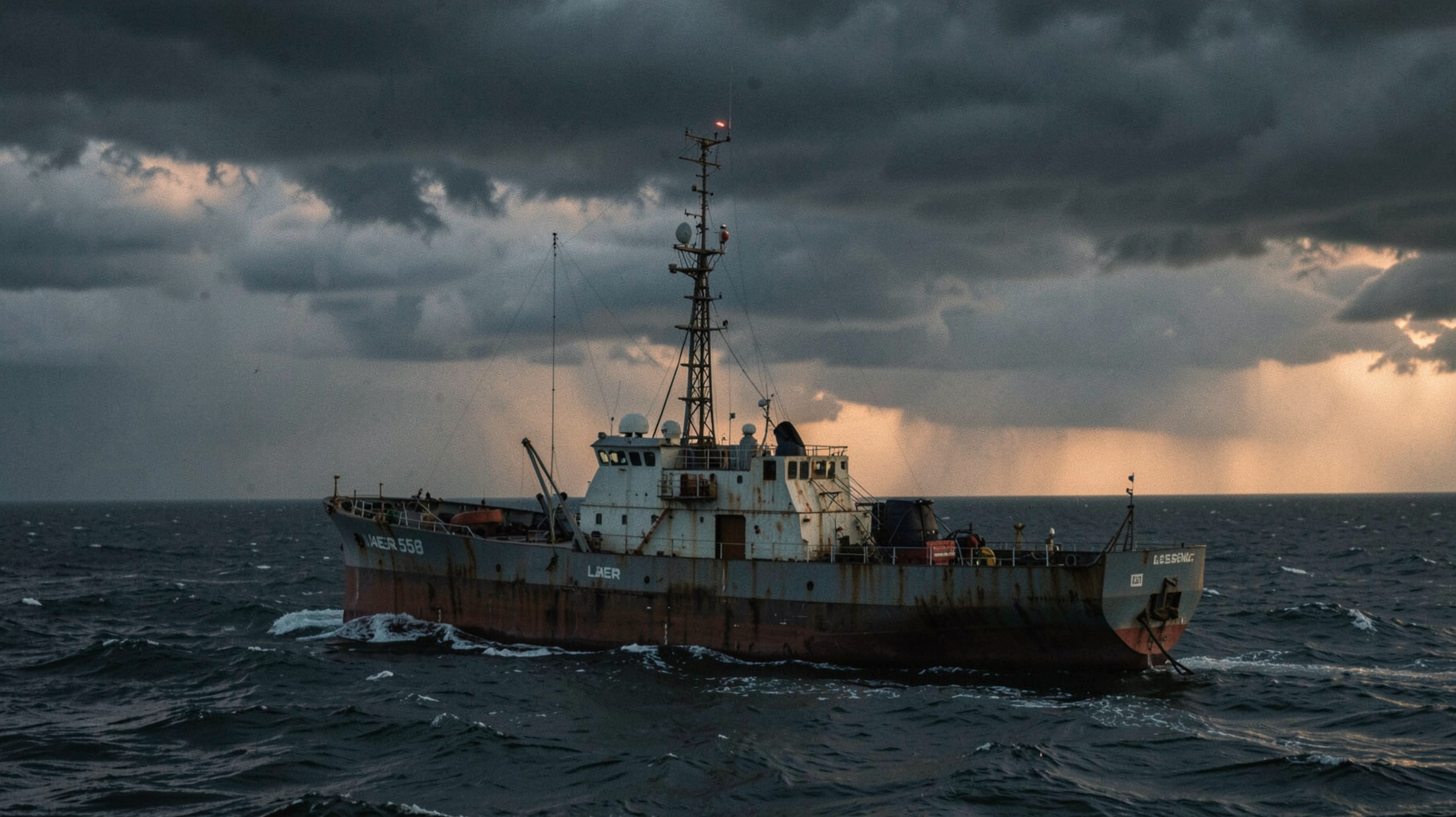
Laser 558 built an audience of millions from a rusting former survey vessel anchored in the North Sea, ran a British government surveillance operation into hundreds of thousands of pounds in costs, and ended its original run when a generator failure during a storm forced its ship into port for good.
A London Car Salesman's Ship in International Waters
Laser 558 launched in May 1984 from the MV Communicator, a Panama-registered former hydrographic survey vessel anchored off the Thames Estuary, founded by London car salesman John Kenning and Irish businessman Philip Smyth, according to the station's Wikipedia entry. Anchoring in international waters let the station broadcast into Britain, the Netherlands, Belgium and northern France on 558 kHz AM without a UK license, exploiting the same offshore loophole earlier pirate stations had used since the 1960s.
Never More Than a Minute Away From Music
The station's entire appeal came down to a single programming rule, never more than a minute away from music, a direct contrast to UK commercial radio's 50 percent speech requirement and BBC Radio 1's similar talk quotas at the time. Paired with American disc jockeys like Charlie Wolf and Rick Harris and a total absence of ad breaks, that format pulled in an estimated 4 million UK listeners along with comparable audiences across continental Europe within months of launch.
A Government Operation Called Eurosiege
By August 1985 the British Department of Trade and Industry had launched an operation nicknamed Eurosiege, anchoring monitoring vessels near the Communicator at a reported cost of £50,000 a month to track the station's broadcasts. It was an expensive, sustained response from a government that saw Laser and its fellow offshore pirate Radio Caroline as enough of a threat to justify round-the-clock surveillance at sea.
A Storm, a Failed Generator, and Silence
On the night of November 4, 1985, deteriorating weather triggered generator problems aboard the Communicator, and the crew radioed for emergency help. Programming continued into the next morning until 12.21pm on November 5, when the music stopped and the transmitter switched off for good. The ship sailed into Harwich under escort the following day and was impounded by creditors, eventually selling at auction for around £35,000, a fraction of the nearly £1 million it had cost just two years earlier.
Back on Air, Decades Later
The Laser 558 name resurfaced briefly as Laser Hot Hits in 1986 before folding again in 1987, and the original ship was eventually scrapped in Orkney around 2004. In 2023, LASER558 Ltd revived the brand as a licensed online station, bringing back original DJs including Rick Harris, Erin Kelly, Jeff Davis and Chris Carter to run a full daily schedule. What started as an illegal broadcast from a ship dodging British law is now a legally licensed station carrying the same name, the same DJs, and the same 80s sound to a new generation of listeners.