
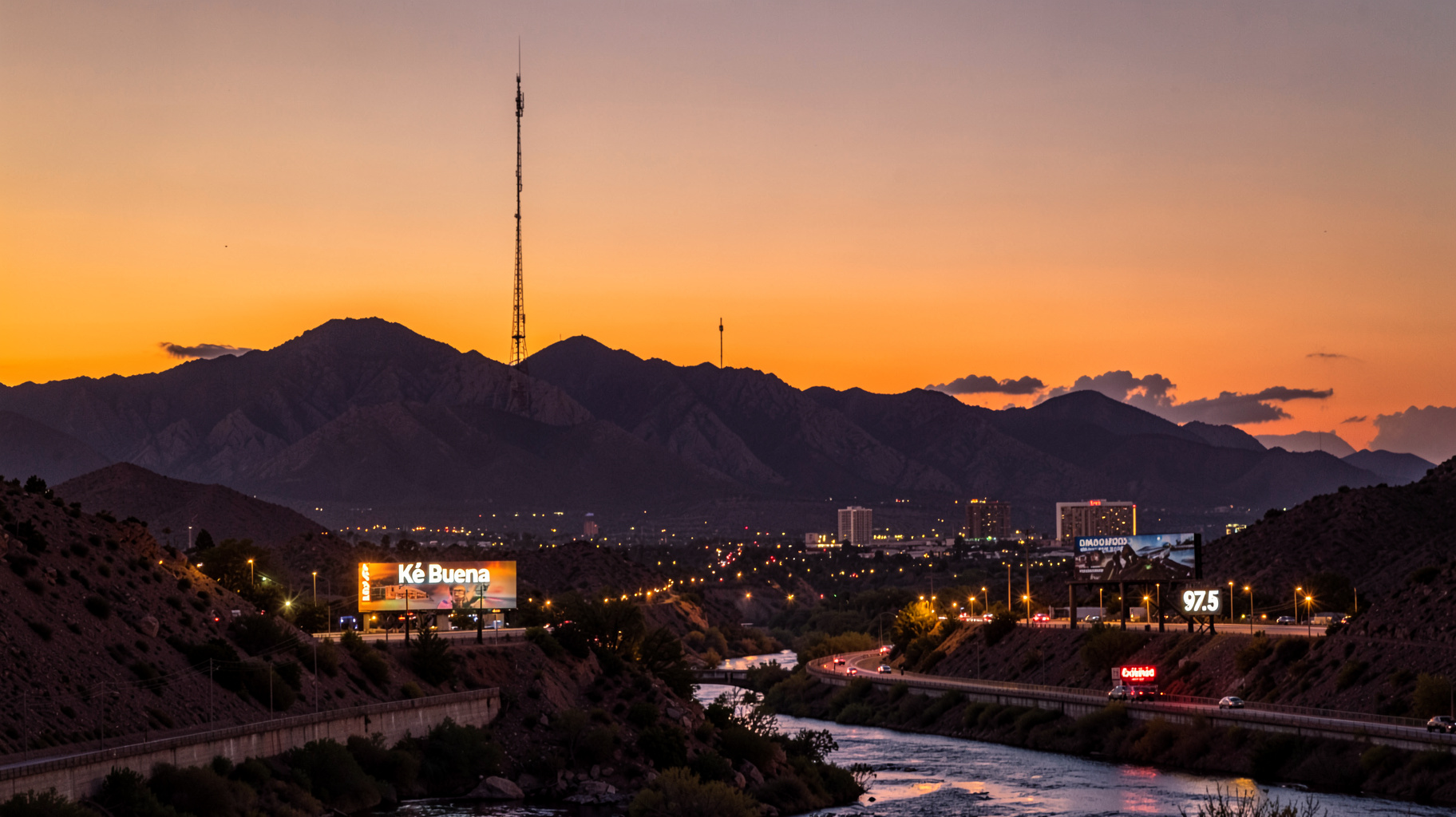
KBNA-FM didn't start out as a Spanish-language station at all. It spent its first sixteen years cycling through progressive rock, top 40 and disco before a change in ownership pointed it toward the format that would define it for the next four decades and turn it into one of the loudest signals on the US-Mexico border.
From Progressive Rock to Disco
The station signed on February 16, 1969, as KINT-FM under Sun County Broadcasting, launching with a progressive rock format that stood in contrast to its AM sister station's contemporary hits sound, according to the station's Wikipedia entry. Jim Tabor and his father bought the stations in 1974 and built out studios that would eventually move to Radio Center on Trowbridge, and by the mid-1970s the station had drifted toward top 40 and disco. A 1982 sale to Great American Broadcasting brought a rename to KYSR-FM, a call sign that lasted only three years.
The 1985 Flip That Stuck
Everything changed in 1985 when Tichenor Radio, a company built around Spanish-language broadcasting, acquired the station and flipped it to Regional Mexican music under the call sign KBNA and the branding "Ké Buena," Spanish for "how good." That format has held for roughly forty years since, longer than any of the station's earlier English-language identities combined. Ownership kept moving in the decades after: Univision Communications bought the Tichenor stations in 2003, sold KBNA-FM to a Grupo Radio Centro affiliate in 2016 for roughly $2 million, and operations shifted again in 2022 to Pro Radio LLC, a subsidiary of Grupo Audiorama Comunicaciones, which runs the station today.
A Signal Built to Cross the Border
KBNA-FM broadcasts at 100,000 watts horizontal and 48,000 watts vertical from a transmitter in the Franklin Mountains, a power level that pushes the signal well past El Paso proper into Las Cruces, New Mexico, and across the Rio Grande into Ciudad Juárez. That reach matters in a market this specific: El Paso and Ciudad Juárez together form the largest binational metropolitan area on the US-Mexico border, with a combined population above 2.4 million people that functions as a single integrated cross-border community, linked by shared workforces, manufacturing and daily commuting.
A Border Market Where Spanish Leads
Spanish-language programming carries more weight on the El Paso-Juárez dial than in any other major Texas radio market, reflecting a metro area that is over 80 percent Hispanic. A Regional Mexican station transmitting at full power from the Franklin Mountains isn't a niche play in that context, it's programming built for the market's actual center of gravity. Four decades after Tichenor's 1985 format flip, Ké Buena 97.5 remains one of the signals designed to be heard on both sides of the border at once.