
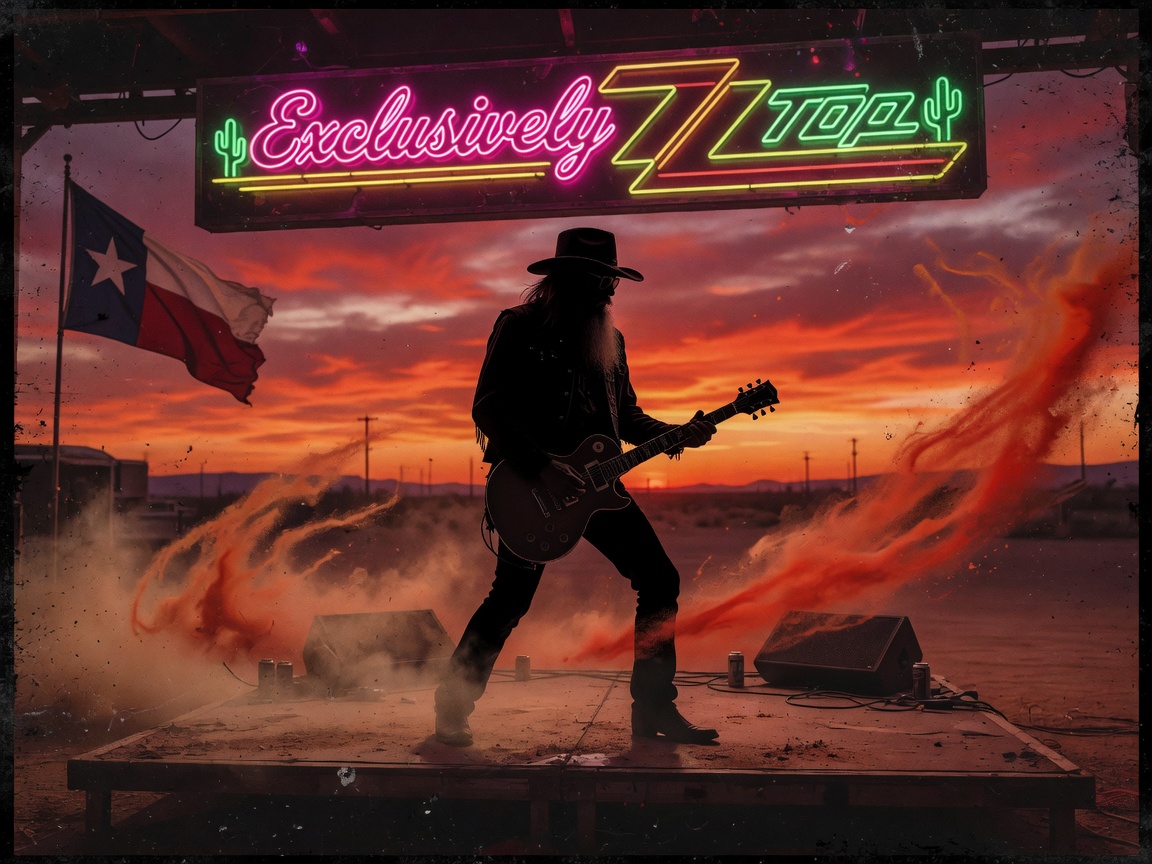
Somewhere in the sprawling catalog of Exclusive Radio's single-artist channels, tucked between a thousand other stations each devoted to one act and one act only, sits a stream with a simple promise: nothing but ZZ Top, all day, every day. The station broadcasts as part of the Exclusive Radio network out of the UAE, an operation that has built more than a thousand of these hyper-focused channels, one per artist, spanning decades of rock, pop and everything between.
What makes the ZZ Top channel worth a second look isn't the novelty of a single-artist format, it's the catalog behind it. ZZ Top formed in Houston in 1969, when guitarist Billy Gibbons, bassist Dusty Hill and drummer Frank Beard came together after passing through a handful of other Texas bands. Their first show as a trio was at the Knights of Columbus Hall in Beaumont in February 1970, and remarkably, that same lineup stayed intact for more than five decades, a stretch of stability that earned the group a Guinness World Record in 2018 for the longest-running band with zero personnel changes.
From Texas Blues Bars to the Eliminator Era
The band's sound was built on Gibbons' blues playing, pulling directly from influences like John Lee Hooker and Muddy Waters, filtered through Hill and Beard's tight, rhythm-first backbone. That foundation carried the band through its early blues rock years and into the breakout success of 1973's "La Grange," but the real turning point came a decade later. Eliminator, released in 1983, reworked the band's blues rock core around synthesizers and drum machines, a sound that produced "Gimme All Your Lovin'," "Sharp Dressed Man" and "Legs," and turned three bearded Texans into an unlikely fixture of early MTV. The band was inducted into the Rock and Roll Hall of Fame in 2004, and in 2022 released Raw, a soundtrack tied to the documentary That Little Ol' Band from Texas that traced the group's full arc back to its earliest Gulf Coast blues roots.
A Single-Artist Station in a Crowded Field
Running an entire station around one act is a bet that the catalog can carry the weight on its own, and ZZ Top's fifteen studio albums give the format plenty to work with, from deep blues cuts most casual fans have never heard to the arena-sized hits that still get FM airplay decades later. For listeners who already know exactly what they want, skipping the algorithm and the DJ chatter in favor of a stream that plays only Gibbons, Hill and Beard is arguably the whole appeal.
It is a small, specific promise, but it is one the station keeps, and for anyone whose relationship with ZZ Top runs deeper than the classic rock radio staples, that consistency is worth tuning into.