
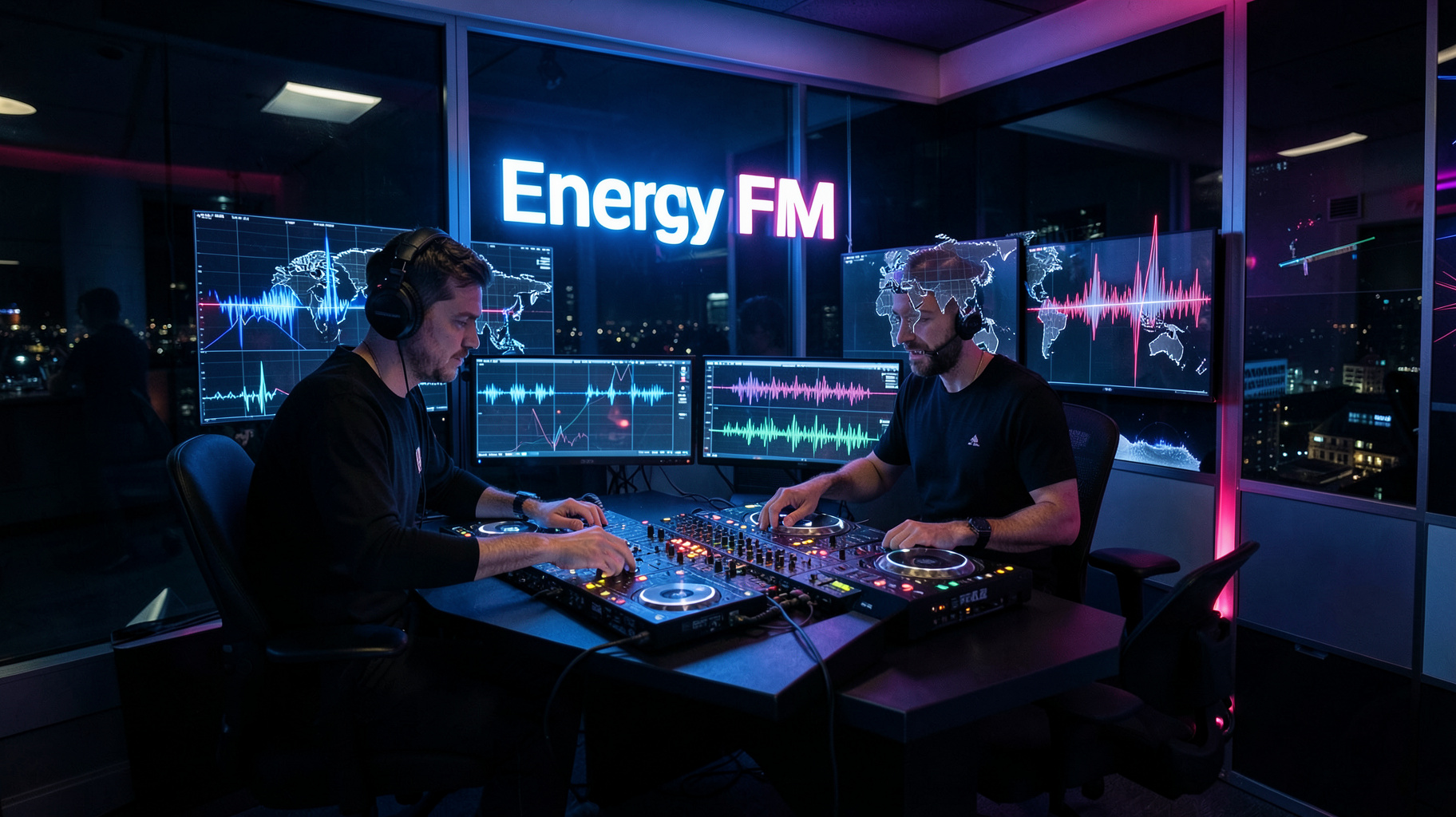
Energy FM has streamed dance music from London since 2003, a modest independent station running on trance, house and old school classics. Look at its actual weekly schedule, though, and it reads less like a small internet radio operation and more like a syndication hub for some of the biggest names in electronic music.
An Independent Station Built on Dance Music
Energy FM launched in 2003 as an independent internet station out of London, built around house, trance and dance music rather than a single narrow subgenre. Alongside its main stream, the station runs an Old School Classics channel covering disco, soul, funk and pop, and a Non-Stop Mixes channel that runs continuous DJ sets around the clock, giving it three distinct ways to reach dance music fans rather than one.
A Schedule Full of Franchise Shows
What sets Energy FM apart from most independent stations its size is its programming lineup. Its schedule carries Eric Prydz's Epic Radio, Fedde Le Grand's Darklight Sessions, Paul van Dyk's Vonyc Sessions, Don Diablo's Hexagon Radio, Roger Sanchez's Release Yourself, Purple Disco Machine's Purple Disco Tales, and the Defected Radio Show, alongside Oliver Heldens' Heldeep Radio. These are not exclusive productions built for Energy FM. They are globally syndicated shows that major DJs distribute to stations around the world as a promotional arm of their own labels and brands, and Energy FM has positioned itself as a UK home for a large slate of them at once.
What Syndication Actually Reaches
The scale behind that syndication model is worth spelling out. Heldeep Radio alone has passed 575 episodes and now airs on around 180 radio stations across 55 countries, reaching an estimated 80 million listeners a month. Energy FM is one node in that much larger distribution network, a small independent London station plugged directly into a promotional machine built by some of house and techno's most commercially successful artists.
Old School Alongside the New
That global programming sits comfortably next to the station's Old School Classics channel, which keeps disco, funk and pop from earlier decades in rotation for listeners more interested in dance music's history than its current chart-driven present. Running both a globally syndicated contemporary lineup and a dedicated retro channel lets Energy FM serve two very different dance audiences without picking one over the other.
A Small Station With an Outsized Lineup
Energy FM never grew into a major broadcaster in its own right, but it did not need to. By plugging into the syndication networks built by Oliver Heldens, Eric Prydz, Paul van Dyk and others, it offers listeners a schedule of globally recognized shows that most stations its size could never produce independently, proof that syndication can let a small operation punch well above its actual size.