
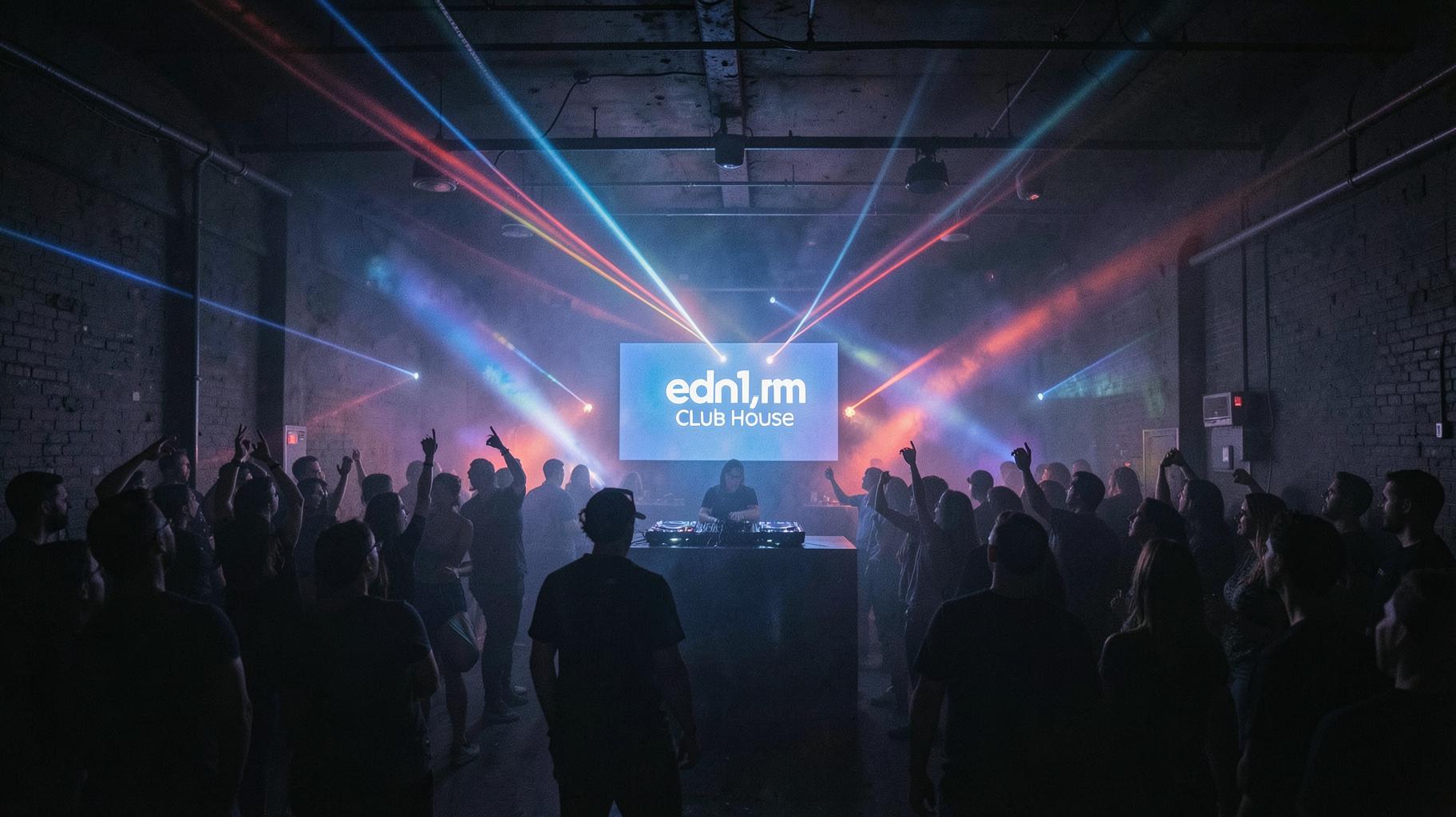
edm1.fm Club House streams a nonstop, real-time DJ mix of house music, a genre whose very name comes from a single building. Long before this station or the internet that carries it existed, a Chicago club called The Warehouse gave the entire sound its identity, and that origin story is still worth knowing every time a house track drops.
Named After the Club That Built It
House music traces to The Warehouse, a former factory space at 206 South Jefferson Street in Chicago, where resident DJ Frankie Knuckles took over as musical director in 1977. Over the next several years Knuckles blended disco, funk, gospel-inflected vocals, and early drum machines into something new, playing for a crowd that was mostly Black, Latino and gay, an audience drawn to a room built specifically as a space free from the racism and homophobia they faced elsewhere. The sound that came out of those nights became known simply as house music, named for the club itself.
From One Room to a Global Chart Presence
What started in that one Chicago building spread fast once it left the city. By 1986, house tracks pressed on Chicago labels like Trax and DJ International were charting in the UK, carrying the sound across the Atlantic and into the European club scenes that would eventually build entire subgenres, deep house, tech house, jackin' house, on top of Knuckles' original template. Chicago never let go of the credit either: the city renamed the stretch of street where The Warehouse once stood "Frankie Knuckles Way" in 2004, declaring August 25 of that year Frankie Knuckles Day.
A Station Built on the Mix, Not the Track
edm1.fm, the network Club House belongs to, launched around 2020 under Kadonn Media LLC with a specific philosophy: electronic club tracks are meant to be heard inside a continuous DJ mix, not looped individually or played back to back with silence in between. That's why Club House and its seven sister channels, covering everything from deep house to trance to peak-time techno, run as live-mixed streams rather than standard playlists, an attempt to recreate the unbroken flow of an actual club set rather than simulate radio in the traditional sense.
A Small Network Carrying a Big Legacy
Club House itself doesn't have decades of its own history the way its genre does, but that's arguably the point. It exists to keep a continuous, faithfully mixed version of a sound that started in one room in Chicago available to anyone with an internet connection, decades after Frankie Knuckles first built it out of disco records and a drum machine for a crowd that needed somewhere to belong.