
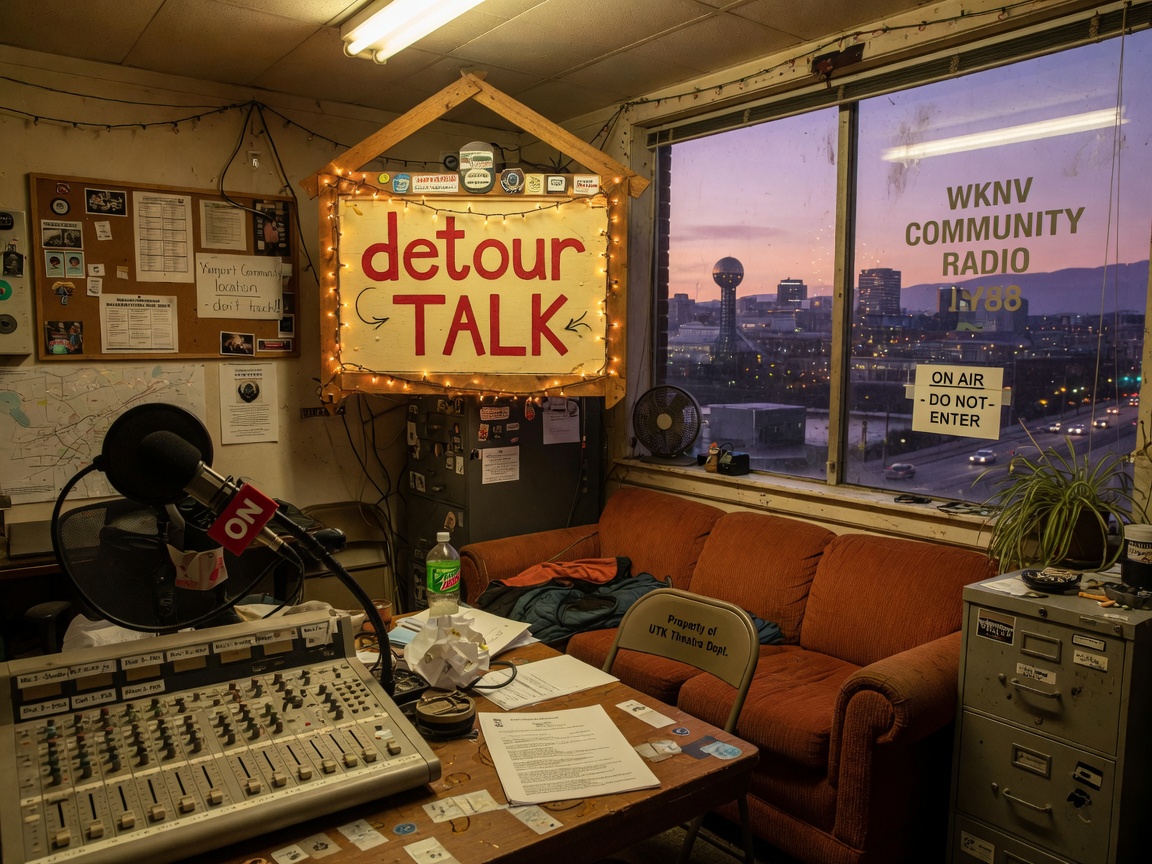
In Knoxville, Tennessee, a nonprofit called Purple Zebra Services runs a small radio network built on one rule: anyone interested in getting on the air is allowed to try. detour TALK is the half of that network built around conversation, carrying progressive and independent talk programming that reaches East Tennessee over the air and the rest of the world online.
A Two-Station Network Built on One Rule
detour TALK is one half of what its operators call the detour network, a pair of non-commercial, community-based stations run under a "community access" philosophy, according to the network's own mission page. Rather than gatekeeping who gets airtime, the network invites local producers, activists and everyday listeners to bring their own shows, a structure closer to public access television than a conventional commercial format.
A Lineage That Goes Back to 1949
detour TALK carries that community-first approach through its affiliation with the Pacifica Radio Network, the oldest listener-sponsored radio network in the United States. Pacifica traces back to pacifist Lewis Hill, who co-founded KPFA in Berkeley in 1949 as the first station in the country funded directly by listeners rather than advertisers or institutions, according to accounts of Hill's work. Nearly eight decades later, that same funding philosophy underpins a small Tennessee station built around the idea that radio should answer to its audience rather than sponsors.
What Actually Airs on detour TALK
The programming reflects that independence directly, covering everything from politics and health to technology and environmental issues through a mix of local and internationally syndicated shows from progressive and independent producers. The goal, as the network describes it, is offering perspectives that corporate radio tends to avoid, run by a media source with no large corporate owner shaping what gets covered.
A Sister Station With No Program Director
detour TALK's counterpart, detour MUSIC, takes the community access philosophy even further, rejecting a fixed format entirely. Hosts there operate with what the network describes as "complete and total freedom," moving between alternative, rap, country, reggae, bluegrass, techno, jazz and more within a single freeform station, refusing to sort music into the genre boxes most commercial stations rely on.
Local Roots, Global Reach
Both stations are built around East Tennessee, reaching listeners across Knoxville, the Tri-Cities, Johnson City, Bristol, Kingsport, Chattanooga, Maryville, Oak Ridge, and the Smoky Mountains towns of Pigeon Forge and Gatlinburg. The internet stream extends that same community-access mission well past those city limits, giving anyone the chance to hear a station that still runs on the same principle Pacifica set in 1949: radio built for listeners first.