
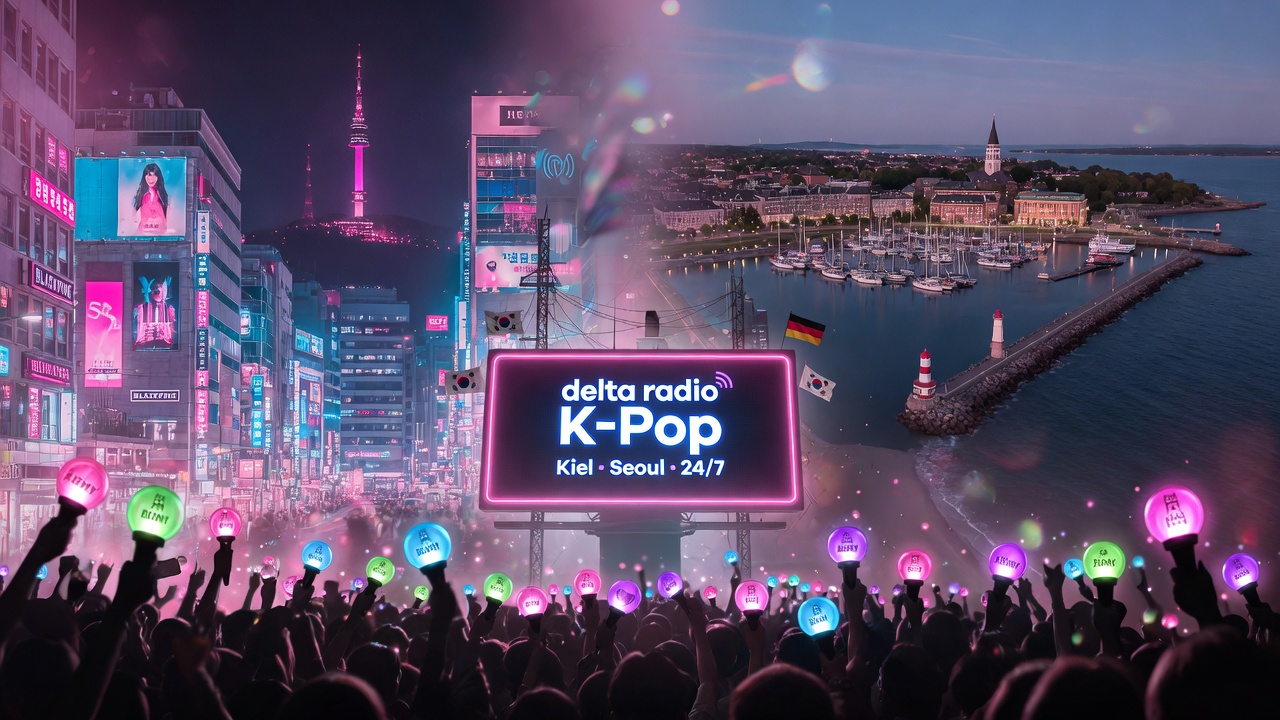
delta radio built its reputation in Kiel giving Northern German and Scandinavian rock bands a foothold in the Central European market, broadcasting under the slogan "Klingt anders," meaning it sounds different. Since 2018, that same broadcaster has run a stream that sounds different in an entirely new way: a dedicated, nationwide feed of nothing but Korean pop.
A Station Built to Sound Different
delta radio signed on July 1, 1993 as a rock-focused alternative to Kiel's public broadcasters, quickly becoming, according to background on Wikipedia, a focal point for Northern German and even Scandinavian bands looking to break into the Central European rock scene. That mission gave the station a distinct identity in a regional radio market otherwise dominated by public broadcasting.
Independent by Design
The station operates as part of Mach3 Broadcasting alongside sister stations Radio Schleswig-Holstein and the now-defunct Radio NORA, with France's Lagardère Group holding a stake in the group. Unlike NDR or SWR, delta radio runs without government subsidy or public ownership, a structural independence the station treats as central to its identity within Germany's broadcasting landscape.
From Rock Breakout Ground to K-Pop Stream
That same independent operation launched delta radio K-Pop in 2018, a dedicated Korean pop stream distributed nationwide across Germany over the internet, licensed by the Medienanstalt Hamburg/Schleswig-Holstein under delta Radio GmbH's Kiel operation, according to the regulator's own station listing. Rather than building a separate company, the rock broadcaster simply extended its existing Kiel infrastructure to cover a genre with almost nothing in common with its original alternative rock format.
What Actually Plays on the Stream
The stream runs current K-pop hits from acts including BTS, Monsta X, Blackpink, Red Velvet, Seventeen, Got7 and Sistar, giving German K-pop fans a dedicated feed rather than scattered plays buried inside a broader pop rotation. It fills a specific gap in German radio, where Korean pop rarely gets consistent airtime on mainstream stations despite a growing, dedicated fanbase.
One Broadcaster, Two Very Different Audiences
The pairing looks unlikely on paper, a station once defined by breaking Scandinavian rock acts now running a round-the-clock K-pop feed, but it reflects how far Kiel's independent broadcaster has been willing to stretch beyond its original format. delta radio's core station still sounds different from Germany's public broadcasters. Its K-pop stream just proves the company is willing to sound different from itself too.