
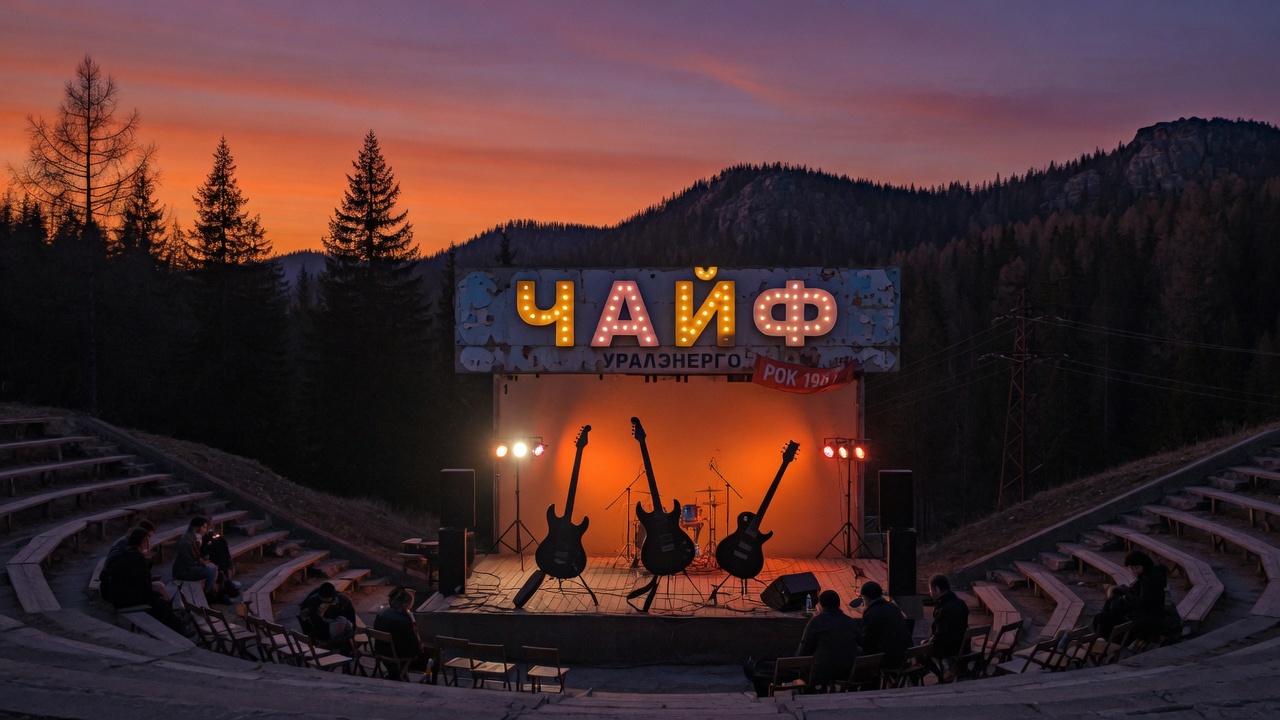
Before there was a legal way to release rock music in the Soviet Union, there were magnitoalbums: cassette tapes recorded in apartments and copied by hand, passed from city to city through informal networks that functioned like a black market for sound. Chaif (Чайф) built their first audience this way. Formed in 1984 in Sverdlovsk, the city that is now Yekaterinburg, by Vladimir Shakhrin and Vladimir Begunov, two friends who met in school and bonded over Creedence Clearwater Revival, T. Rex, and the Rolling Stones, the band became one of the defining acts of Soviet and post-Soviet Russian rock. The radio station Чайф, found in Radio Shuffle, dedicates its stream entirely to their catalog.
Born in Sverdlovsk: The Urals Rock Scene That Produced Something Real
Sverdlovsk in the 1980s was not supposed to produce world-class rock bands. It was an industrial city in the Ural mountains, closed to foreigners, operating under the full weight of Soviet cultural control. But its rock club, the Sverdlovsk Rock Club, became one of the USSR's most fertile breeding grounds for honest music during the glasnost era. Chaif joined the club as it was developing, alongside bands like Nautilus Pompilius and others who would become the Ural rock generation.
The name Чайф comes from the two Russian words "chai" (tea) and "kaif" (slang for pleasure or bliss), a private joke between Shakhrin and Begunov that became the band's identity. Their earliest recordings circulated on magnetic cassettes before official release was possible, and those tapes built a genuine following across Soviet cities based purely on word-of-mouth. When official releases became available, the audience was already there.
The Sound of the Urals: What Chaif Actually Plays
Chaif's core sound fuses rock with folk, blues, and occasionally reggae, rooted in working-class directness rather than art-rock abstraction. Guitar-driven arrangements dominate, with simple chord progressions and rhythmic energy that prioritize feeling over technique. Shakhrin's lyrics draw from everyday Soviet and post-Soviet life: scarcity, resilience, ordinary emotion.
- Classic Ural rock, the foundation. Songs like "Ne Speshi" (Don't Rush) and "17," which brought national fame in 1992, show the band's ability to write direct, emotionally resonant material that doesn't require translation to feel true.
- Blues-inflected rock, the American influence that Shakhrin and Begunov grew up with filtered through a Soviet lens, producing something with the grit of Creedence and the poetry of the Russian literary tradition.
- Folk and acoustic textures, present throughout the catalog, including the 1985 acoustic double-set "Zhizn v rozovom dymu" (Life in Pink Smoke) that circulated as their first cassette recording.
- Later catalog work, including the 1996 album "Simpatii," which featured covers of Russian rock legends including Maika Naumenko and Vladimir Vysotsky, and represented the band reconnecting with its roots after years of national touring.
In 1991, Chaif headlined the massive Rock of Clean Water (Рок чистой воды) festival at Luzhniki Stadium in Moscow, a tribute to Viktor Tsoi of Kino who had died the previous year. It was one of the largest rock events in post-Soviet Russian history, and Chaif's presence confirmed their standing as one of the generation's defining acts.
Yekaterinburg and the Ural Rock Tradition
Yekaterinburg, formerly Sverdlovsk, has a legitimate claim to being Russia's most important rock city. The Sverdlovsk Rock Club produced not just Chaif but Nautilus Pompilius and several other bands that defined Russian alternative music in the late Soviet period. The city's industrial identity, its distance from Moscow's cultural gatekeepers, and the dense concentration of technical university students created conditions where authentic music could develop without commercial pressure. Chaif was one of the last bands admitted to the Rock Club before it was shut down, which makes their timeline a precise slice of one of the most interesting moments in modern Russian cultural history.
The band has released over 33 albums across four decades, toured throughout Russia and the former Soviet states, and remains active. Listeners who know the name from the 1990s heyday will find the catalog deep; listeners discovering Chaif for the first time through this radio station are about to spend a long time catching up.
Stream Чайф Free on Radio Shuffle
Tune in to Чайф on Radio Shuffle — no account, no app, no fee. Hit play and you're somewhere in the Ural industrial sprawl of the 1980s, where two friends who liked Creedence too much decided to make their own version of it, and ended up defining a generation.