
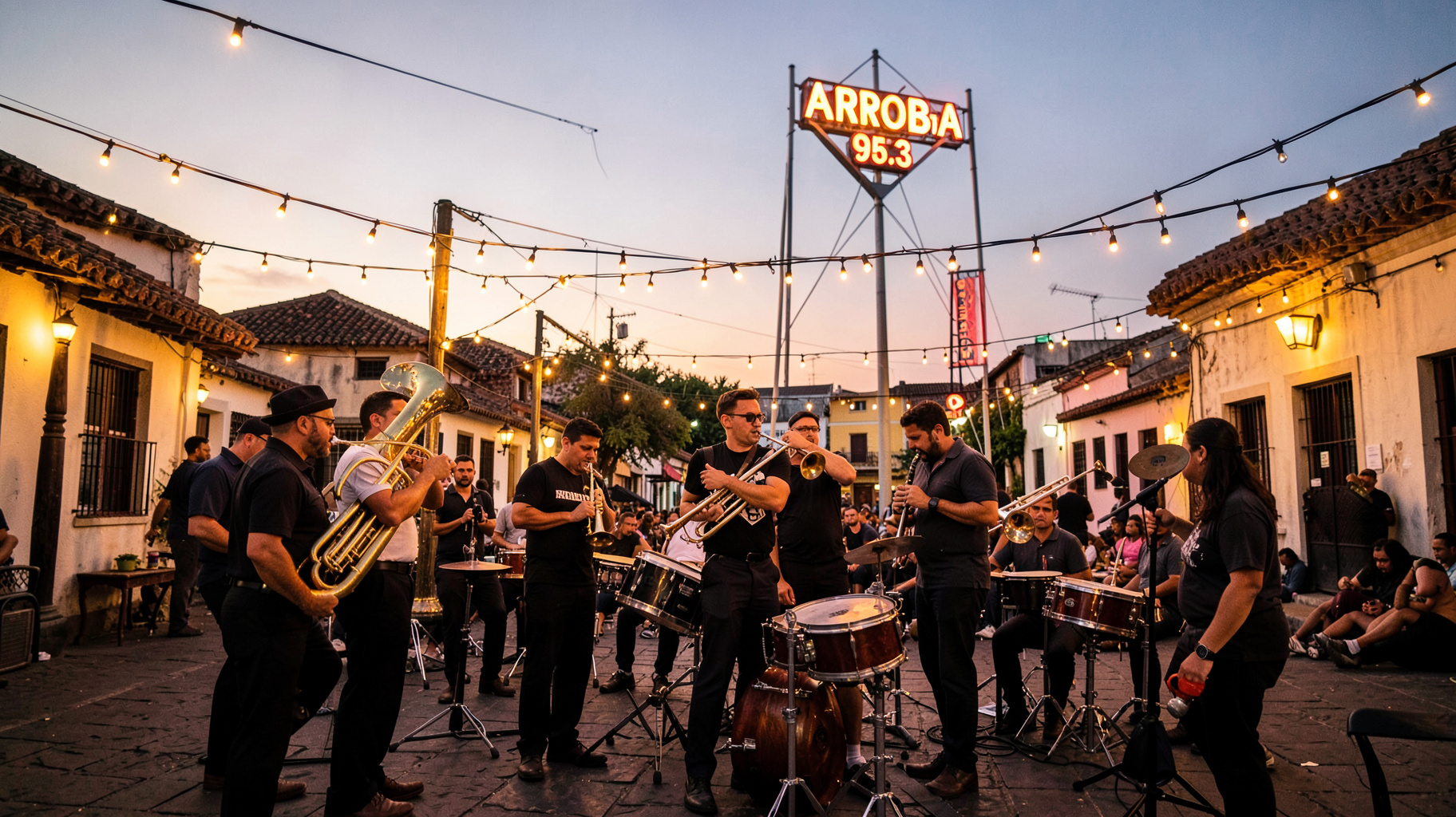
Arroba FM Culiacán plays Latin pop and English-language hits to a young audience on 95.3 FM, part of Grupo Radiorama's youth-focused @FM network. The frequency itself is older than its current sound, and it broadcasts from a state whose real musical signature is a brass band tradition that predates pop radio by a century.
One Frequency, Two Formats
XHIN-FM received its broadcast concession on November 28, 1988, according to its station record, and for years operated as La Plakosa, a grupera-format station under Grupo Radiorama. The frequency now carries a dual identity, branded on air and online as "La Plakosa Arroba FM 95.3," reflecting a shift toward Radiorama's @FM youth pop format alongside its older grupera roots, a rebrand that gradually pulled the station's programming toward the Latin pop and contemporary hits it plays today.
A City Named by the Culhua
Culiacán, the Sinaloan capital where XHIN-FM broadcasts, takes its name from the Náhuatl "Kolwahkan," meaning place of the Culhuas, after a settlement the Culhua people founded there around 628 CE. Spanish colonizers resettled the area as the Villa de San Miguel in 1531, and the modern city grew up where the Tamazula and Humaya rivers meet to form the Culiacán River at the foot of the Sierra Madre Occidental, a geography that shaped the city's identity long before any radio tower stood in it.
The State That Gave Mexico Banda Music
Sinaloa's real musical export is banda sinaloense, a brass band style built around the tambora, a double-headed bass drum topped with a cymbal that anchors the group's rhythm. The sound grew out of 19th-century German military and municipal bands that took hold along Mexico's Pacific coast, and by 1920 the state had standardized its own instrumentation. The genre took its regional name two decades later, once the group Banda el Recodo began advertising its music as exclusively Sinaloan, cementing a brand identity the state's brass bands still carry today.
Pop Radio in a Banda State
Arroba FM Culiacán's youthful pop and Latin hits format is a deliberate departure from that brass band inheritance rather than an extension of it, giving the city's younger listeners something closer to Latin American and North American chart music than the tambora-driven sound Sinaloa is famous for. Both traditions now share the same 95.3 dial position and the same station history, a frequency that has carried grupera, banda-adjacent programming and now pop under one Radiorama roof since 1988.