
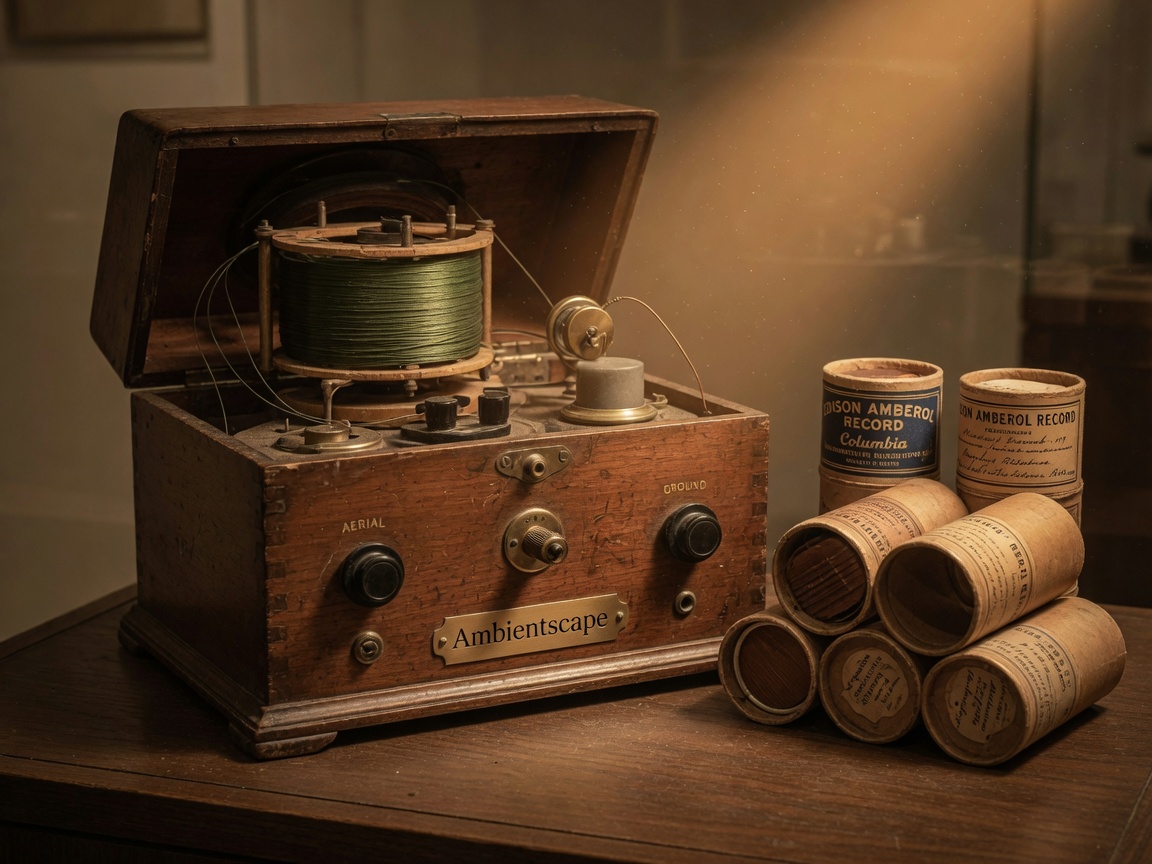
Most ambient stations are just playlists with reverb. The Ambientscape Project is something else entirely, a UK preservation initiative that digitizes century-old wax cylinder recordings and then broadcasts world music live through an actual antique crystal radio set, no amplifier, no power supply, just a coil, a galena crystal, and a signal.
Named for Brian Eno, Built to Preserve Voices Archives Left Out
Founder Jonathan Emeruwa established the project in 2022 as a direct homage to Brian Peter George Eno, the composer who coined the term "ambient music" (Ambientscape). But the mission runs deeper than a tribute. The project digitizes historical phonograph cylinders and discs, with particular focus on underrepresented voices from Africa, the African diaspora, and indigenous communities, making rare sound documents publicly accessible outside traditional institutional archives for the first time. The project is explicit about the ethical stakes involved, drawing on archivist Lae'l Hughes-Watkins' framework that reparative archival work "acknowledges these failures and engages in conscious actions toward a wholeness" (Ambientscape).
The Northcote Thomas Wax Cylinder Collection
Among the archive's most significant holdings is a body of recordings made by Northcote Whitridge Thomas, a British anthropologist who served as Government Anthropologist for the Colonial Office and conducted four surveys across Nigeria and Sierra Leone between 1909 and 1915, working with the Edo, Igbo, Temne, and Limba peoples. With local assistants, Thomas documented songs, stories, and music onto wax phonograph cylinders alongside thousands of photographs, and the Ambientscape Project hosts this collection with permission from curator Paul Basu (Ambientscape).
A Signal Powered by Nothing but Sound
The station's live broadcast runs through an original 1923 BBC Radiola "Bijou" crystal set manufactured by the British Thomson-Houston Company, a receiver that needs no power supply at all, drawing its faint signal straight from the radio waves themselves through a galena crystal detector, the same technology that first made home radio reception possible in the early 20th century (Ambientscape).
- Weekly live broadcast, every Thursday at 10:00 PM GMT, streamed at an intentionally lo-fi 128kbps in mono.
- Restored wax cylinder recordings, ethnographic and archival music pulled directly from the preservation project.
- Royalty-free ambient compositions, newly created binaural and contemplative pieces produced by the project itself.
- Archived catch-up recordings, available at full 320kbps quality for anyone who misses the live Thursday slot.
No Ads, No Commentary, Just the Recreation
The broadcast deliberately avoids advertising, DJ commentary, or visuals, aiming instead to recreate what the project describes as the earliest historical music broadcast experiments, distortion, surface noise, and limited dynamic range included rather than cleaned up (Ambientscape). It's a station that treats imperfection as historically accurate rather than something to engineer away.
Why It's Worth a Spot in Your Rotation
If you want ambient and world music radio with an actual research mission behind it, not just a mood playlist, the Ambientscape Project offers something no algorithm-built station can replicate: recordings rescued from obscurity, broadcast through the exact technology that once made radio itself feel like magic.
Stream The Ambientscape Project Free on Radio Shuffle
Tune in to The Ambientscape Project on Radio Shuffle, no account, no app, no fee. Press play and hear a century of preserved sound arrive the way radio first sounded.