
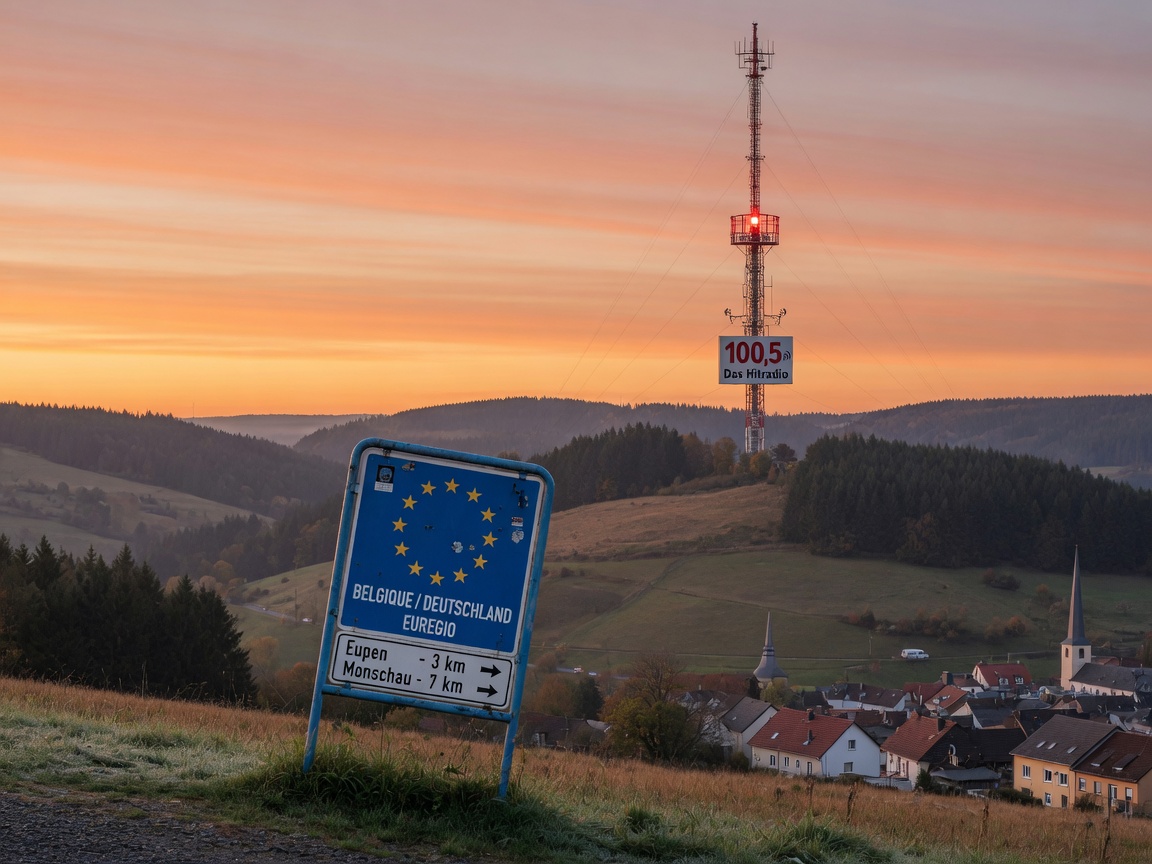
Some radio stations get called pirates because they broke the law. 100,5 Das Hitradio gets called one because it followed the wrong country's law for the audience it was actually chasing.
Launched From Belgium's German-Speaking Corner
The station signed on October 19, 1998, broadcasting out of the studios of BRF, the public broadcaster of Belgium's German-speaking Community, in the border town of Eupen. According to the station's own history, BRF originally held 51 percent of the venture alongside German broadcaster Radio Salü at 49 percent, with Harald Gehrung becoming general manager the following January. That founding partnership set the template the station has followed ever since: legally Belgian, but built from the start with an eye on the German-speaking listeners just across the frontier.
Legally Belgian, Aimed at Germany
Today the station is licensed as a regional broadcaster under Belgian law, with ownership split between the Deutschsprachige Gemeinschaft Belgiens (via Proma AG), Radio Salü, PFD Pressefunk, and regional publishers Mediahuis Aachen and Grenz-Echo AG. That license lets it broadcast entirely legitimately inside Belgium. The catch is that its real target audience sits mostly in southwestern North Rhine-Westphalia, in and around Aachen, Germany, a market it was never licensed to serve under German broadcasting law. The station has reportedly avoided opening a studio inside Aachen specifically to protect its Belgian license, a workaround that keeps it compliant on paper while still reaching deep into German territory over the air.
Why Germany Calls It a Pirate
That cross-border setup is exactly why the station is described, from a German regulatory standpoint, as a kind of pirate station, despite holding a fully legal Belgian license the entire time. It is a genuine regulatory paradox: nothing about the station's operation breaks Belgian law, yet its business model depends on serving a German audience that Belgian licensing was never designed to cover. Few stations anywhere in Europe sit quite so deliberately on top of a national border.
A Regional Hits Format for the Euregio
Musically, the station keeps things straightforward, mixing current chart hits with familiar tracks from past decades and running news updates every thirty to sixty minutes, split evenly between regional and national coverage. Reaching an estimated 1.1 million German speakers between the ages of 29 and 45 across the wider Euregio Meuse-Rhine area, according to its own audience figures, the station functions less like a niche outlet and more like the default hits station for a region that happens to straddle a border most listeners barely think about day to day.
Tune in to 100,5 Das Hitradio on Radio Shuffle for the border-crossing hits station broadcasting legally from Belgium straight into Germany's Euregio.